ARTICLE AD
The 200-hour is where every yoga teacher starts. The 300-hour builds on it and is only for those who already have the 200-hour. The 500-hour combines both into one program. Which one fits you depends on where you are right now, not on how motivated you feel.
If you are planning to become a yoga teacher, you have probably already noticed that choosing the right certification feels more confusing than it should. The numbers alone do not tell you much. And most articles just list the curriculum without actually helping you decide.
This guide does things differently. It explains what each program actually involves, what it costs, what you can do after completing it, and how to match the right level to your situation right now.
200 vs 300 vs 500-Hour Yoga Teacher Training(Quick Comparison)
| Who it is for | Anyone new to teaching | Teachers with a 200-hour cert | Anyone wanting full training at once |
| Prerequisite | None | Completed 200-hour YTT | None |
| Duration (intensive) | 3 to 4 weeks | 4 to 5 weeks | 8 to 10 weeks |
| Cost in India (with stay) | $1,200 to $2,000 | $1,200 to $2,000 | $1,600 to $4,500 |
| Yoga Alliance credential | RYT 200 | RYT 500 (with experience) | RYT 500 (with experience) |
| Can beginners enroll? | Yes | No | Yes |
| Best suited for | Getting started as a teacher | Specializing and advancing | Fast-tracking to RYT 500 |
All three are recognized by Yoga Alliance, which is the most widely accepted certification body for yoga teachers worldwide.
Which Yoga Teacher Training Should You Choose (Based on Your Situation)
If you are still unsure after comparing the options, this simple breakdown will help you decide faster.
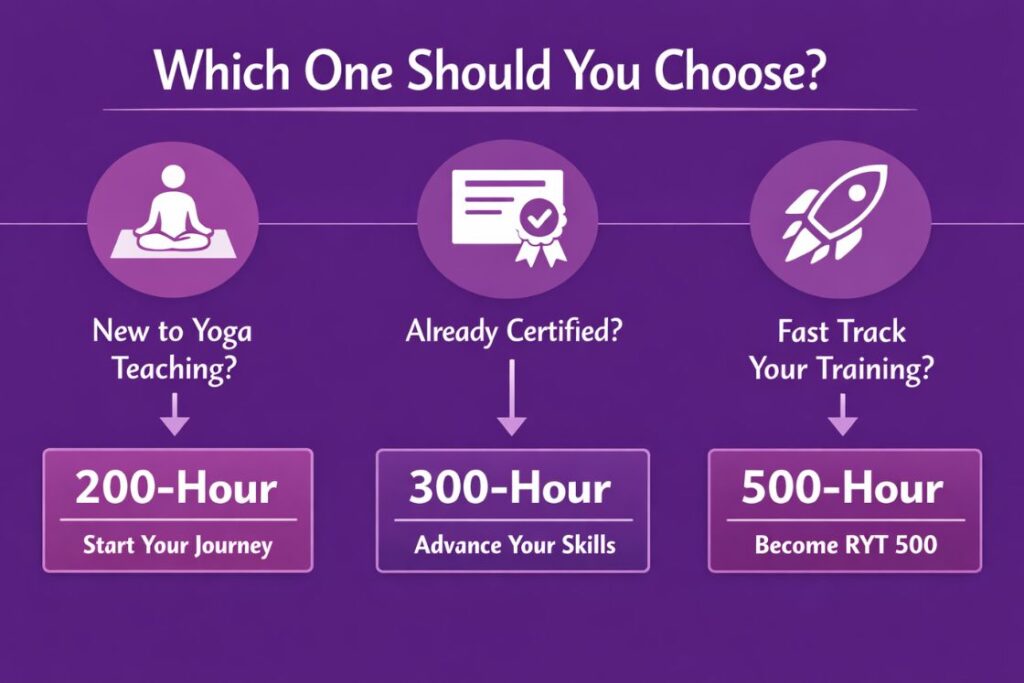 If you are a beginner with no certification → Choose the 200-hour yoga teacher training
This is where every yoga teacher starts. It gives you the foundation to understand asana, pranayama, and teaching basics so you can begin teaching safely and confidently. If you already have a 200-hour certification → Choose the 300-hour yoga teacher training
This level is designed to deepen your knowledge, improve your teaching skills, and help you specialize in a particular style or student group. If you want to complete everything in one go → Choose the 500-hour yoga teacher training
This combines both 200 and 300-hour training into one program. It is ideal if you can commit the time and want to reach an advanced level without taking a break.
👉 In simple terms:
Start with where you are right now, not where you want to be. The right choice is the one that matches your current experience, time, and learning goals.
200-Hour Yoga Teacher Training: The Foundation Certification
What the 200-Hour Actually Covers
The 200-hour is the entry-level certification for yoga teachers. It is the minimum standard that most yoga studios and gyms around the world require before they will let you teach a class. Think of it as your starting point, not your finish line. It gives you the tools to teach safely and confidently, but it does not make you an expert overnight.
There are no prerequisites. You do not need previous teaching experience, a certain number of years of practice, or any formal yoga background. You do need a genuine interest in yoga and a readiness to learn.
How the 200 Hours Are Divided
100 hours in techniques, training, and practice covering asanas, pranayama, kriyas, meditation, and chanting 20 hours in teaching methodology, which includes cueing, sequencing, time management, and student communication 20 hours in anatomy and physiology, covering how the body moves and how to avoid injury 30 hours in yoga philosophy, lifestyle, and ethics, including Patanjali’s Yoga Sutras and the eight limbs 10 hours of practicum, which means actual teaching with feedback from instructors 55 hours of electives based on your school’s specialty, whether that is Vinyasa, Hatha, Kundalini, or Yin 20 hours of non-contact study such as self-study, assignments, and journalingThe elective section is worth paying attention to when comparing schools. A school rooted in Kundalini yoga will use those 55 hours very differently from one focused on Ashtanga or Yin. The credential may be the same, but the actual learning experience varies a lot depending on what the school specializes in.
What You Can Do After the 200-Hour
After completing a 200-hour program at a Registered Yoga School (RYS 200), you can apply to Yoga Alliance as an RYT 200, which stands for Registered Yoga Teacher. You will also need to log 100 hours of teaching experience after your training to complete that registration.
With an RYT 200, you can teach group yoga classes at studios, gyms, and community centers, offer private sessions, teach online, and work at schools internationally that recognize Yoga Alliance credentials.
200-Hour Yoga Teacher Training Cost in India & Abroad
In India, which is the most popular destination for yoga teacher training, costs are roughly:
Without accommodation: Rs. 20,000 to Rs. 30,000 With accommodation and meals included: Rs. 1,00,000 to Rs. 1,50,000 (around $1,200 to $2,000 USD)Online programs can start as low as $200 to $1,000 USD, though you give up the hands-on practice that in-person training provides.
In the USA or Europe, in-person programs generally cost $2,500 to $5,000 or more.
Price is not a reliable measure of quality. Yoga Alliance requires every registered school to meet the same curriculum standards, regardless of what they charge. Always verify that your chosen school is listed as an active RYS on the official Yoga Alliance website before you pay anything.
Who Should Do a 200-Hour Yoga Teacher Training (Best For Beginners?)
This is the right program if you want to start teaching yoga and have not yet, if you are still figuring out whether teaching is something you want to pursue seriously, if you want to deepen your personal practice even without a goal of teaching, or if you are working within a budget or time constraint. A large number of people complete the 200-hour with no immediate plans to teach and still find it one of the most valuable things they have done.
300-Hour Yoga Teacher Training: Advanced Training and Specialization
What the 300-Hour Is and What It Is Not
The 300-hour is not a standalone program. You cannot enroll in it unless you have already completed a 200-hour certification. This is a firm requirement set by Yoga Alliance, not a preference left up to individual schools.
What it does is take everything you learned in the 200-hour and go considerably deeper into each subject. It also gives you a large block of elective hours, 140 out of 300 total, to specialize in a particular style of yoga or a specific population of students. This is where teachers start developing a real teaching identity rather than just a general certification.
How the 300-Hour Differs from the 200-Hour
| Techniques and Practice | 100 hrs | 50 hrs |
| Teaching Methodology | 20 hrs | 5 hrs |
| Anatomy and Physiology | 20 hrs | 15 hrs |
| Philosophy and Ethics | 30 hrs | 30 hrs |
| Practicum (actual teaching) | 10 hrs | 30 hrs |
| Electives (specialization) | 55 hrs | 140 hrs |
| Self-Study | 20 hrs | 30 hrs |
The reduction in techniques and methodology hours is intentional. The 300-hour assumes you already have a working foundation, so those hours shift toward practicum and electives. You spend three times as many hours actually teaching compared to the 200-hour, and more than twice as many hours in your chosen specialty.
How Much Deeper Does the Learning Go
In asana practice: You move past foundational poses into advanced ones including arm balances, deep backbends, and inversions. You also learn detailed alignment and hands-on adjustment techniques for each, and how to modify safely for students dealing with injuries or physical limitations.
In philosophy: The 200-hour introduces core concepts like Patanjali’s Yoga Sutras, the eight limbs, and Pancha Vrittis. The 300-hour goes further into texts like the Bhagavad Gita, Shad Darshanas, Puranas, and subtle body concepts such as Antahkaranas and Pancha Koshas. This is not just academic. It genuinely changes how you speak about yoga with students and how you structure your classes.
In anatomy: You go from general body mechanics to understanding how specific conditions like hypermobility, scoliosis, and chronic pain affect what is safe and helpful in a yoga practice. This is where teaching begins to move into therapeutic territory.
In specialization: This is the most significant difference. You choose a direction, whether that is Yin yoga, prenatal yoga, yoga therapy, trauma-informed teaching, or a specific style like Vinyasa or Kundalini, and spend 140 hours going deep into it. Some teachers use this to work with a specific population. Others use it to develop their own unique approach to teaching.
What You Can Do After the 300-Hour
Combined with your 200-hour, completing a 300-hour program at an RYS 300 makes you eligible to register as RYT 500 with Yoga Alliance, the highest standard teacher registration available. You will need a combined total of 100 hours of teaching experience to complete that registration, which many teachers will have accumulated between their 200-hour and 300-hour training.
What It Costs
Costs are similar to the 200-hour:
In India without accommodation: Rs. 20,000 to Rs. 30,000 In India with accommodation and meals: Rs. 1,00,000 to Rs. 1,50,000 (roughly $1,200 to $2,000 USD) Online: $600 to $1,500 USD USA or Europe: $2,500 to $5,000 or moreWho Should Do the 300-Hour
This is the right program if you have completed your 200-hour and have spent some time teaching, if you want to specialize in a particular style or student population, if you want to qualify for RYT 500 without committing to a full 500-hour program at once, or if you are actively teaching and feel ready to go deeper. One thing experienced teachers often say: the 300-hour hits differently after you have real students. If you can teach for six months to a year before enrolling, the advanced curriculum becomes much more meaningful.
500-Hour Yoga Teacher Training: Complete Training in One Program
What the 500-Hour Actually Is
The 500-hour combines the 200-hour and 300-hour into a single continuous program. It is not a separate or higher level of certification. It is simply one way of reaching the same destination as doing both programs back to back, just without the gap in between.
This is a point of confusion for many people: when someone holds an “RYT 500,” it does not necessarily mean they completed a 500-hour program. It just means they have 500 total hours of Yoga Alliance recognized training. Doing a 200-hour followed by a 300-hour, or completing a single 500-hour program, both lead to the identical credential.
How the 500 Hours Are Divided
150 hours in techniques, training, and practice 30 hours in teaching methodology 35 hours in anatomy and physiology 60 hours in yoga philosophy, lifestyle, and ethics 40 hours of practicum 145 hours of electives 40 hours of self-practice and learning activitiesThe depth mirrors what you would get from doing the 200 and 300 separately. Nothing is abbreviated. You go from foundational learning all the way to advanced specialization without stopping.
How Long It Takes
An intensive residential program runs 8 to 10 weeks. Part-time or online formats can stretch to 6 to 12 months. This is the largest time commitment of the three options, and that is worth thinking about seriously. Eight to ten weeks away from work, family, or existing responsibilities is not something to plan casually.
What It Costs
In India with accommodation and meals: Rs. 1,00,000 to Rs. 2,50,000 (roughly $1,600 to $4,500 USD) Online: $1,000 to $3,000 USD USA or Europe: $4,000 to $8,000 or moreWhile the 500-hour costs more than either individual program alone, it often works out cheaper than doing the two programs separately when you factor in two sets of travel costs, especially if you are training abroad.
Who Should Do the 500-Hour
This is the right program if you want the highest level of training without a break between the two levels, if you can commit fully for 8 to 10 weeks at once, if you would rather handle everything in one go instead of returning for a second program later, or if you are ready to go deep from day one. One thing to go in knowing: because you complete both levels continuously, you will not have any teaching experience between the foundational and advanced parts of your training. That is a real difference from doing the 200 and 300 separately. Many people handle it fine, but it is honest to acknowledge it.
Which Yoga Teacher Training Certification Is Best for Your Career
This is the real question behind most searches on this topic, so it deserves a direct answer.
RYT 200 is the baseline that most yoga studios and gyms require before they will hire you. Without it, your teaching options are limited to places that do not require credentials at all.
RYT 500 gives you a real advantage for specialist roles such as prenatal, therapeutic, or senior yoga, for working with private clients, for leading workshops and retreats, and for getting into higher-end studios that prefer advanced credentials. It also opens the door to teaching teacher training programs yourself, though most schools will want you to hold E-RYT status before taking on that role.
Does RYT 500 automatically mean higher pay? Not by itself. What the advanced training does is build the depth of skill and the confidence that tends to attract better clients and more consistent opportunities over time. The credential signals your level of commitment. Your actual skill and experience is what builds your income.
Typical Yoga Teacher Earnings
New teachers at studios: $15 to $30 per hour Experienced teachers: $30 to $70 per hour Private clients and workshops: considerably higher, depending on your market Online teaching: widely variable but scalable over timeGeography plays a large role here. Teaching in Mumbai or Delhi is a very different market from teaching in New York or London. Rates, demand, and what credentials matter most will vary significantly by location.
Understanding Yoga Alliance Credentials: RYT, RYS, E-RYT Explained
These terms appear constantly when researching yoga teacher training. Here is what they mean and how they connect to each other.
YTTC stands for Yoga Teacher Training Course. This is the actual program you attend.
RYS stands for Registered Yoga School. A school must be registered with Yoga Alliance to issue recognized credentials. Always check that your chosen school appears as an active RYS on the Yoga Alliance website before enrolling.
RYT stands for Registered Yoga Teacher. This is what you become after completing a program at an RYS and logging the required teaching hours.
E-RYT stands for Experienced Registered Yoga Teacher. This is a seniority designation for teachers who have accumulated significant experience:
E-RYT 200: 1,000 or more hours of teaching, with RYT 200 registration held for at least 2 years E-RYT 500: 1,000 or more hours of teaching after earning RYT 500, held for at least 2 yearsE-RYT status matters most if you want to become a lead trainer in other teacher training programs. Most reputable schools require their senior faculty to hold E-RYT credentials.
You can combine a 200-hour and a 300-hour from two different schools, as long as both are registered RYS schools with Yoga Alliance. You also need to renew your RYT registration every 3 years, which requires completing 30 hours of continuing education with at least 10 of those as contact hours.
Common Questions About Yoga Teacher Training
1. Can I skip the 200-hour and go straight to the 500-hour?
Yes. The 500-hour program is designed to accept complete beginners because it includes the foundational level as part of the curriculum. The 300-hour, however, requires a completed 200-hour certification before you can enroll.
2. How long does each program take?
The 200-hour typically takes 3 to 4 weeks in an intensive format or 3 to 6 months part-time. The 300-hour takes 4 to 5 weeks intensive or 3 to 6 months part-time. The 500-hour takes 8 to 10 weeks intensive or up to a year in a part-time format.
3. How long does each program take?
The 200-hour typically takes 3 to 4 weeks in an intensive format or 3 to 6 months part-time. The 300-hour takes 4 to 5 weeks intensive or 3 to 6 months part-time. The 500-hour takes 8 to 10 weeks intensive or up to a year in a part-time format.
4. Can I start teaching immediately after the 200-hour?
Yes. You are qualified to teach as soon as you complete the program. Most new teachers find it helpful to start with smaller settings, assisting experienced teachers, leading classes for friends, or teaching in community spaces before moving into studio environments. It typically takes a few months to feel fully comfortable in front of a class.
5. Is online yoga teacher training recognized the same way as in-person training?
Yes, as long as the school is a Registered Yoga School with Yoga Alliance. The credential is the same. The practical difference is that online training generally builds stronger theoretical knowledge but less hands-on experience with assists, adjustments, and reading a live room. If you already have years of practice, online works well. If you are earlier in your yoga journey, in-person training tends to give you a more complete foundation.
6. Does my 200-hour and 300-hour need to be from the same school?
No. Both programs can be from different schools, as long as each school is registered with Yoga Alliance. Many teachers deliberately choose different schools for each level so they can experience different teaching styles or access a specific specialization.
7.Is Yoga Alliance the only certification worth getting?
It is the most widely recognized globally. In India, certifications from the Ministry of AYUSH, the Indian Yoga Association (IYA), and the Yoga Certification Board (YCB) are also respected, particularly if you plan to teach primarily within India. For teaching internationally or at studios that have a global standard, Yoga Alliance is what most employers and clients recognize.
Final Thoughts: Choosing the Right Yoga Teacher Training Path
Choosing between a 200, 300, or 500-hour yoga teacher training is not just about certification levels. It is about where you are in your journey and how you want to grow as a teacher.
If you are just starting out, the 200-hour gives you the foundation you need. But what truly shapes you is what happens after teaching real students, making mistakes, and learning what works.
The 300-hour becomes much more valuable once you have that experience. It helps you refine your voice as a teacher, specialize, and build confidence in a way that theory alone cannot.
The 500-hour is a different path. It is ideal if you want full immersion and are ready to commit deeply from the beginning. Just remember, it compresses the journey you gain knowledge quickly, but teaching experience will still come after.
In the end, all three paths lead to the same destination. The difference is how you get there.
All course fees and durations mentioned here are approximate and will vary by school, location, and format. Always verify that your chosen school is actively registered with Yoga Alliance at yogaalliance.org before enrolling.