
ARTICLE AD
On July 22, 2026, France became the latest major search market to get AI Overviews.
Which means that, for once, we got to watch the before and after without having to guess. In most markets, AI Overviews crept in alongside algorithm updates and seasonal swings, and we all spent the following year arguing about how much they had really cost us. France had a launch date, and we were already tracking: 963 domains in Google Search Console, over the 28 days before the launch and the 9 days after it.
Xibeijia Guan, our data scientist, pulled and analysed the data for French sites (we explain how in the methodology at the end of this study). Less than a month after launch, Google's AI Overviews are already eating into click-through rates in France.
The domains most exposed to AI Overviews lost more than a fifth of their click-through rate in nine days. The ones barely exposed hardly moved at all.
So this isn't an algorithm update. It's AI Overviews.
Find where an AI Overview shows up in your SERPs
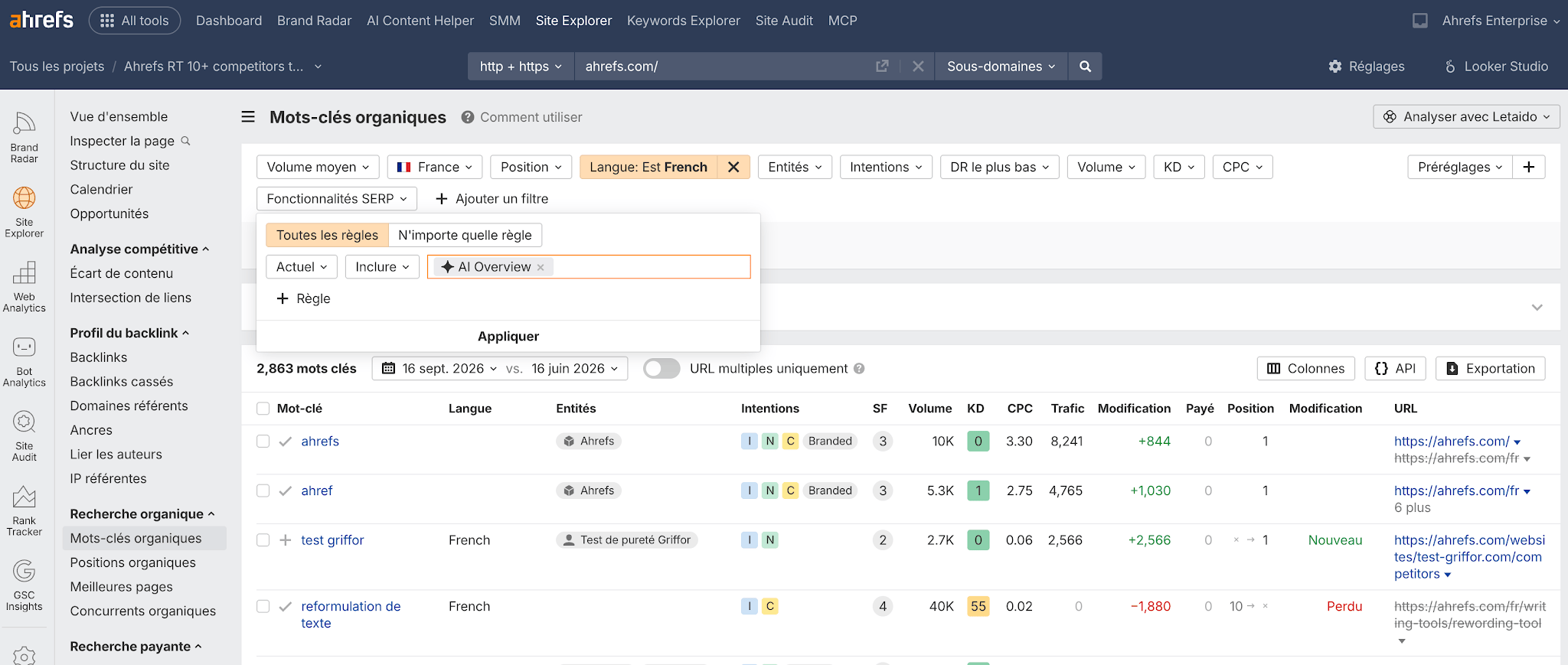
Use the SERP features filter to see exactly which of your rankings trigger an AI Overview. Head to the Organic keywords report in Site Explorer, then select AI Overview in the SERP features filter.
Results
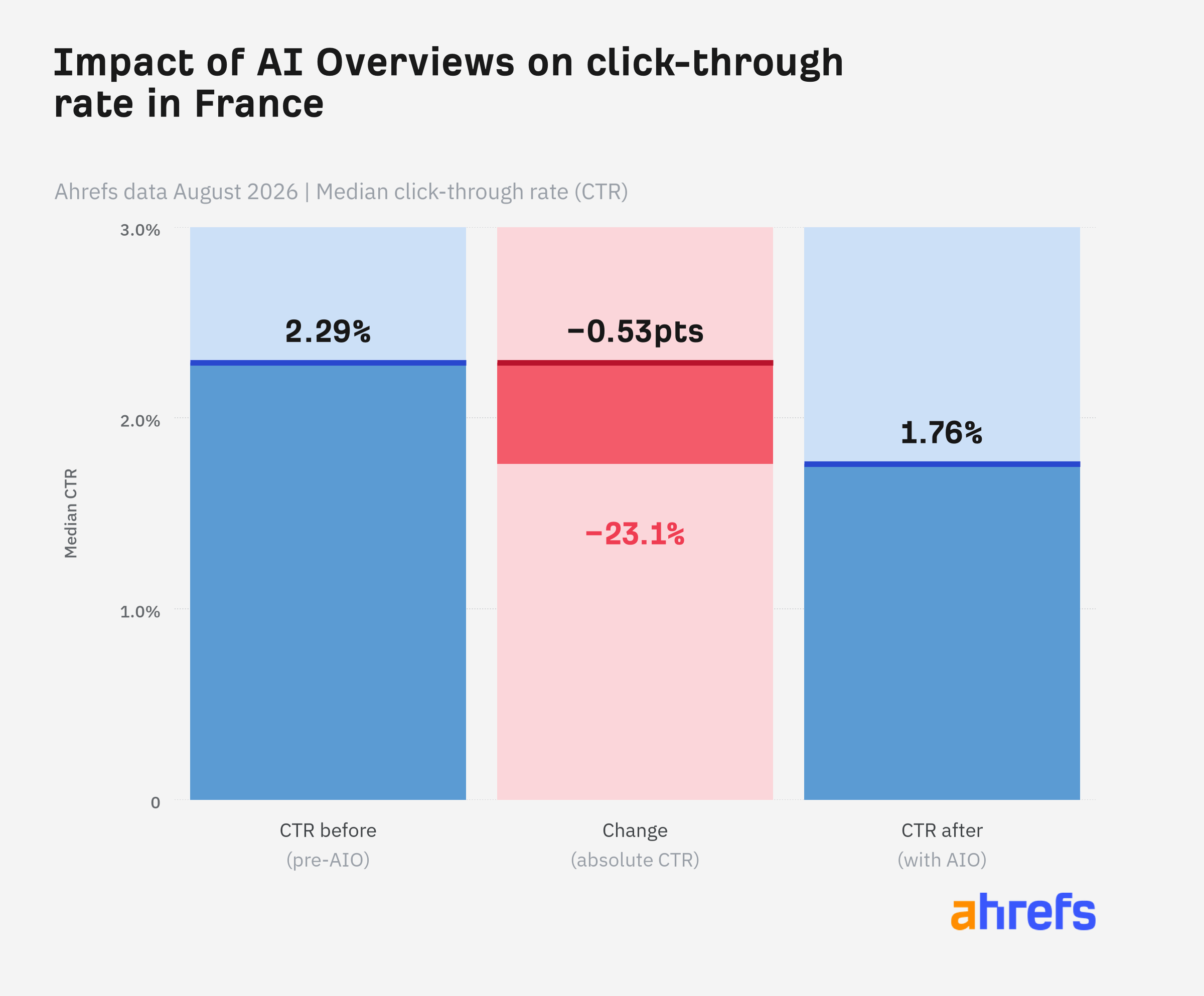
Across the domains we studied, click-through rate fell 3.4% in nine days.
For the domains most exposed to AI Overviews, it fell 23.1%. Six times as much.
And this isn't a handful of unlucky sites dragging the average down: 82.2% of highly exposed domains lost CTR. At that level of exposure, getting away with it has become the exception.
How to estimate what you'll lose
In between those two extremes, the relationship holds pretty steady. If you compare the change in CTR against each domain's AI Overview rate across all 963 domains, you get a slope of −0.9.
In other words: every extra point of AI Overview exposure costs you roughly one point of click-through rate.
If 15% of your queries trigger an AI Overview, expect to lose somewhere around 15% of your CTR. It's crude, but it's actionable: pull your exposure rate from Site Explorer and you have your order of magnitude.
A slope is not a prediction. Some heavily exposed sites are doing fine, and some barely exposed ones are falling apart for reasons that have nothing to do with AI. Your AI Overview rate is a risk factor, not a verdict. We'll check back in a few months to see how these sites actually fared.
Impressions up, clicks down
Barely anyone lost rankings in late July. Pages still show up, just as often as before, sometimes more.
They just get clicked less.
It's the same pattern we found in the global study we ran in late 2025, and the same shape as the great decoupling: an AI Overview doesn't remove you from the SERP, it makes you redundant inside it. The most extreme case in our French panel had +183% impressions for −1.9% clicks, which divides its CTR by more than three.
What it looks like across the whole market
One caveat: that −23.1% describes a minority of sites. Across the full panel, the median is −5.7% CTR and −8.8% clicks.
But that reassuring median hides a brutal distribution.
Almost one site in two lost more than 10% of its daily clicks. One in twenty lost half. In nine days.
And exposure will almost certainly keep climbing. Today the median AI Overview rate among the domains we studied is 5.4%, and 29% of them are already above 10%. Those numbers have only gone one way in every market since 2024.
The .fr domains in our panel lost 12.3% of clicks at the median, against 8.8% for the panel as a whole. French sites are more exposed than the international players competing in the same market.
The worst-hit sector: health
One sector stands clearly apart. Health has an AI Overview rate of 22.2%, the highest in the study, and its click-through rate fell 20.4%.
Health queries are informational, they have short answers, and there's no transaction waiting at the end. That's exactly what an AI Overview absorbs best: the answer fits inside the box, and the user leaves with what they came for.
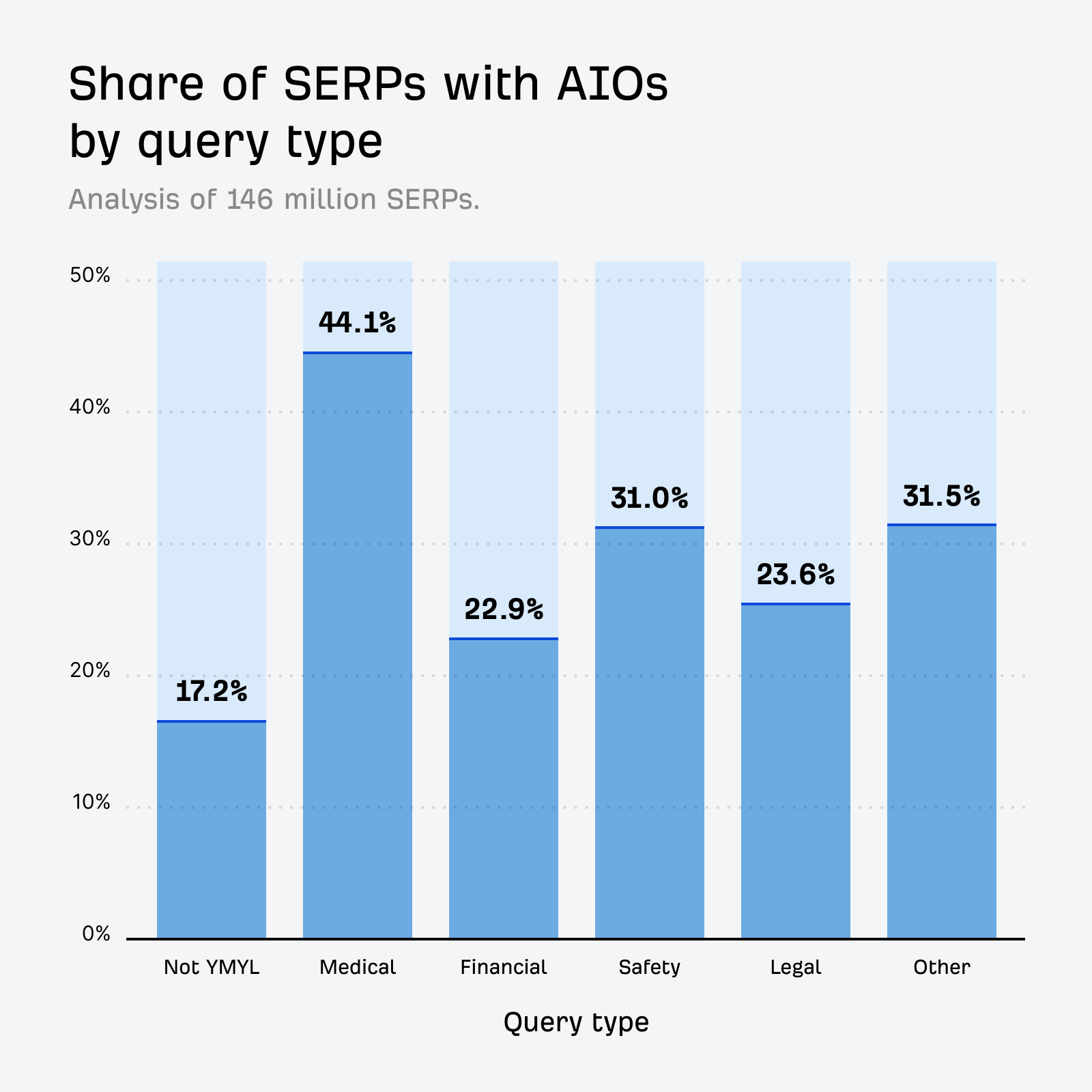
What decides your fate isn't your vertical, it's the intent behind your queries. A query that a single paragraph can answer is a query you're going to lose. A query that needs a tool, an account, a price, a purchase or a human opinion holds up far better.
Look at your keywords through that lens before you look at your industry.
The impact is likely to get worse
That −23.1% is probably not the worst of it.
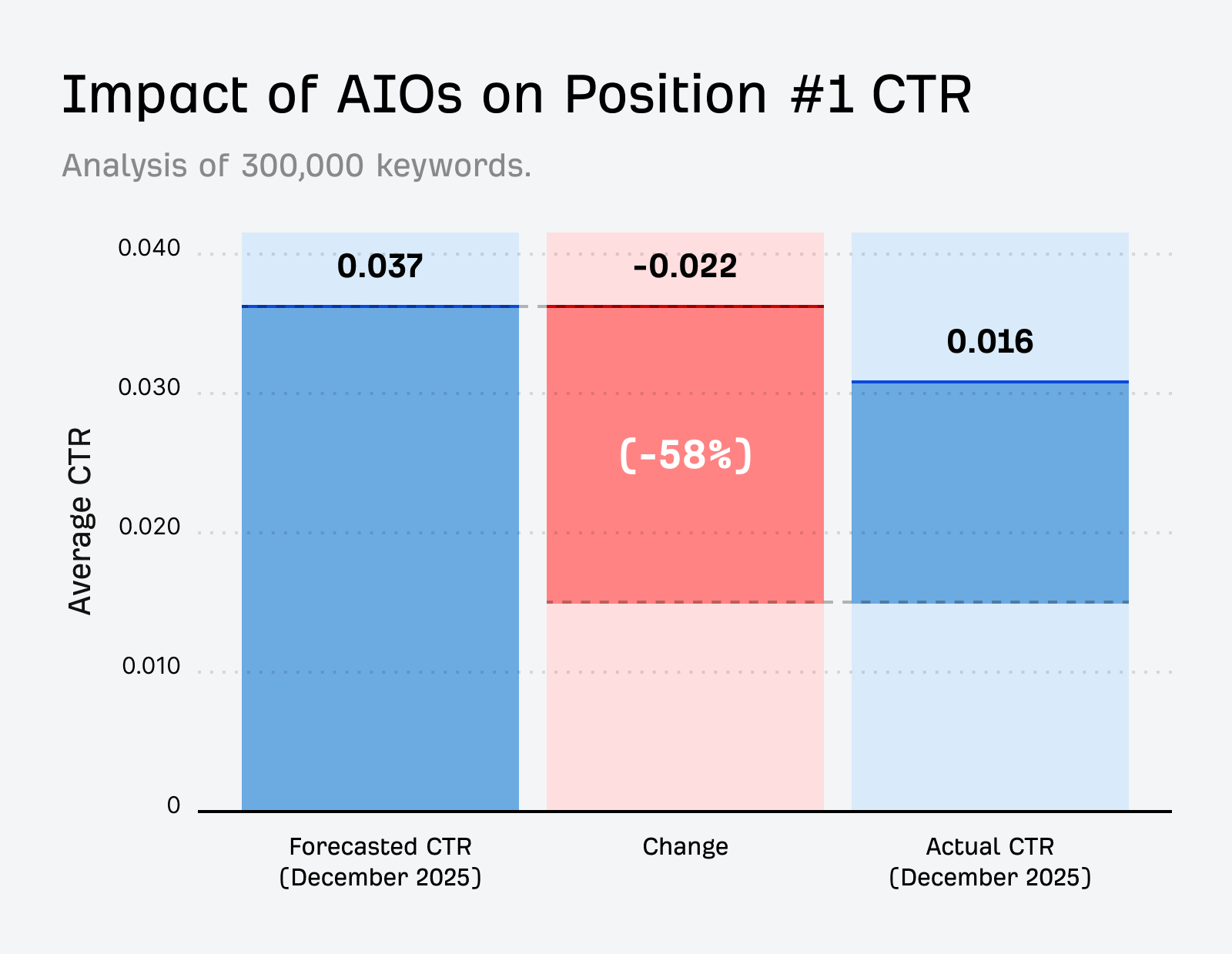
Our global research tracked the same effect over two years: the impact of AI Overviews on position 1 click-through rate went from −34.5% in spring 2025 to −58% by the end of 2025. It doesn't fade with time, it gets worse, as AI Overviews trigger on more queries and users get used to not clicking.
Nothing suggests France escapes that trajectory. We'll re-run this analysis over a longer window to see how far it goes.
Methodology
The −23.1% median CTR figure is the raw observed change for the highly exposed group, with no control adjustment. Over the same period, the control group's CTR rose 2.3%. So highly exposed sites didn't just fall 23%: they also missed the small lift everyone else enjoyed. Once you account for that, the real effect of AI Overviews is −24.8%.
Final thoughts
Two weeks after AI Overviews arrived in France, the most exposed sites had lost a fifth of their click-through rate. The least exposed felt nothing at all. In between, the relationship is linear: roughly one point of CTR per point of exposure.
Three things to take away.
One. Your risk is measurable, and it's measurable before the damage is done. The SERP features filter in Site Explorer gives you your share of queries with an AI Overview.
Two. Stop steering by impressions. They didn't drop. Click-through rate is what took the hit.
Three. These orders of magnitude line up with what others have measured: Seer Interactive reports organic CTR declines of 49.4% to 65.2%, Kevin Indig more than 50%, Authoritas 47.5%. Nobody is measuring the opposite.
Search is going zero-click, and France has just joined the movement.