 10 months ago
17
10 months ago
17 ARTICLE AD
Shangyang Fang’s poetry experiments with the slippages between languages and iterates on classical Chinese forms.
By Shangyang Fang Oct 26, 2025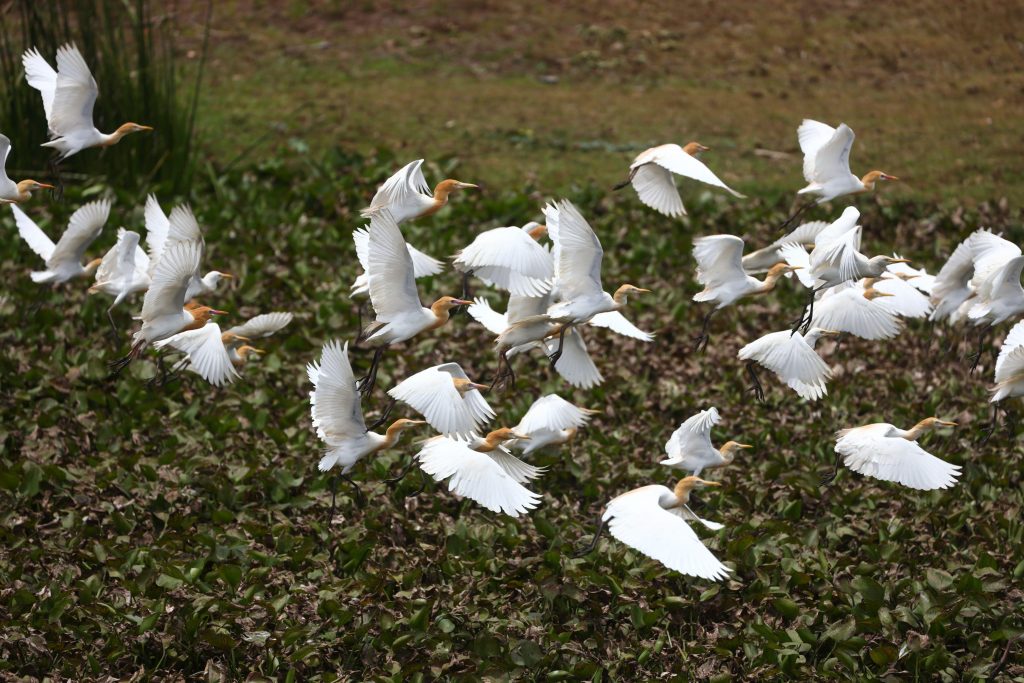 A flock of white egrets flying in search of food over a pond. | Image via Tanongsak Snagthong / Alamy
When Shangyang Fang was born, his father met with a Taoist priest, who said that the newborn lacked water in his life. To compensate for this lack, Fang’s father named him after a mythical one-legged bird who brings forth flood and rain when it dances.
This was perhaps a fitting beginning for Fang, who now works as a poet and translator and often weaves Buddhist and Taoist mythology into his work. Born in Chengdu, China, he began memorizing ancient Chinese poetry at the urging of his grandfather before he could even read or write. “I remember as a child sitting in my father’s office, trying to fit my childish speech into the rhythmic and tonal pattern of the ci [a form of lyrical poetry developed during the Song dynasty],” he said in a 2021 interview.
In addition to translating Song dynasty poetry, Fang iterates on classical Chinese forms in his own writing, playing with the slippages between English and Chinese. “I am obsessed with Chinese poetry; it’s in my bones,” he says. “But writing in a foreign language, I try not to make my native language a shackle, nor a wing. It’s more like a parallel, a shadowy friend walking side by side.”
His first collection of poetry, Burying the Mountain, interpolates Buddhist sutras, translations of Du Fu, and the writings of Paul Celan and Osip Mandelstam as it interrogates themes of emptiness and nothingness, longing and loss, presence and absence, and navigating the unknown. “Writing a poem is like opening a door onto darkness,” he says. “You follow unseeable stairways to ascend or to descend, you jump, you stumble, you crawl, and the path might lead you to a lighthouse or an escarpment, and that’s what makes it exciting to me.”
–Sarah Fleming
Red
By the firewood door
I watch a monk who under plum
boughs sweeps shreds of red
the way this wintry shrine
sweeps all the forgotten travelers
into a crush of petals
brushing the shoulders
of statues, their senseless bodies
drowned in redness.
Beside the stone-arch bridge,
where every blossom is a storm.
In this world of red dust,
how do you know you are
seeing the darkness rather than being
blindfolded? Do you hear
the doe cry at nighttime?
To her, all falling materials replace
their flesh with water.
Being and Time
To see the lotus pond behind a pinewood shrine,
the old man climbs to the top of mountains.
He points to that void in front of him.
“Are those lotuses or people? Or these are
the people, those lotuses?” Pointing to this void
beside him. It has passed the lotus season,
which he spent with his dying wife. Half blind,
the wind strings the creeks into one clink
of a jade ring. A mallet making the bronze
bell tremble. The monks chant. The youngest
one, dozing most of his morning, lifts his
eyelids: that pond full of startled egrets, flitting.
Op. 64 in C♯
to be awake is to find one
-self, raw as a bowl of lilies
waking up in the mirror
Time the Stone Makes an Effort to Flower
Why are we asked to cut
into this realm of red dust?
In the Southern dynasty,
the stars shine bronze swords
upon an eddying evening,
knifing the orchid patterns
over the waist of mountains,
where monks, under oil lamps,
recite the Heart Sūtra.
Their tenuous effort
to harden hearts into rocks.
Their bodies round
by the nightpours becoming
raw plums with no branch
to untwist from.
To reflect is to hold
all the remembered longings
that are lost by time,
and to deflect is to meet
all forgotten faces,
which are eventually one face.
A thousand overlapping
eyelids of hydrangea
are a thousand winecups
beside your grave.
I have no intention to make this
an elegy. Part of me is dead
with you, let that be
the elegy. Part of me so alive—
so extra. All night, ached
by my arms—the unplucked
strings of a lyre : liars
to their own body—I am lured
into clasping an opening
that was once the shape
of you. Parchments of desire,
illegible scribbles—salt line
on your blighted thigh.
Teach me the dark art of doldrums.
Teach me to survive with one
posture like a pebble
in streaklines of river.
But if something survives
the fire, survives
the destruction of forms,
will you walk to me
in this destroyed blue,
as I walk to you
for the rest of my time,
barefoot. Will you touch me,
your finger bones then
synthesized with stems
of chrysanthemums. Will you
return to me
my desire, burning
for the two worlds to meet?
♦
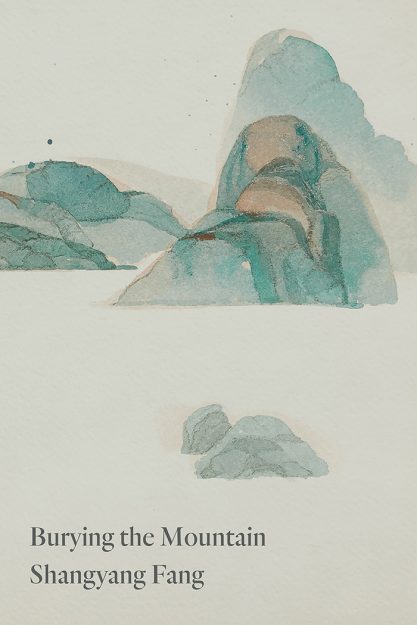
From Burying the Mountain, copyright 2021 by Shangyang Fang, used by permission of Copper Canyon Press, www.coppercanyonpress.org.

Thank you for subscribing to Tricycle! As a nonprofit, we depend on readers like you to keep Buddhist teachings and practices widely available.
This article is only for Subscribers!
Subscribe now to read this article and get immediate access to everything else.
Already a subscriber? Log in.