 5 hours ago
1
5 hours ago
1 ARTICLE AD
A Buddhist art installation in London’s South Bank has viewers meditate on the lessons of impermanence.
By Frank Yau Jul 31, 2026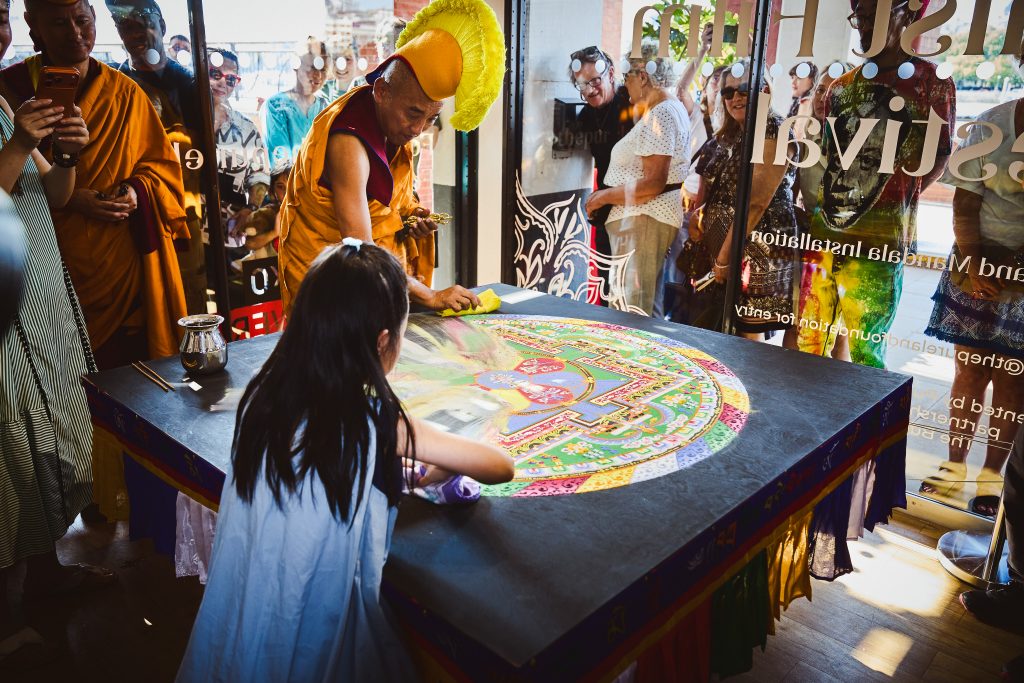 Image courtesy The Pure Land Foundation
For five days at Oxo Gallery, on London’s South Bank, I watched something beautiful come slowly into being, grain by grain.
Presented by the Pure Land Foundation in collaboration with Tricycle: The Buddhist Review, a live sand mandala installation was created by three senior monks over the course of five days. From Wednesday, June 17, through Sunday, June 21, visitors entered the gallery from the noise and movement of the city and found, instead, a space of stillness.
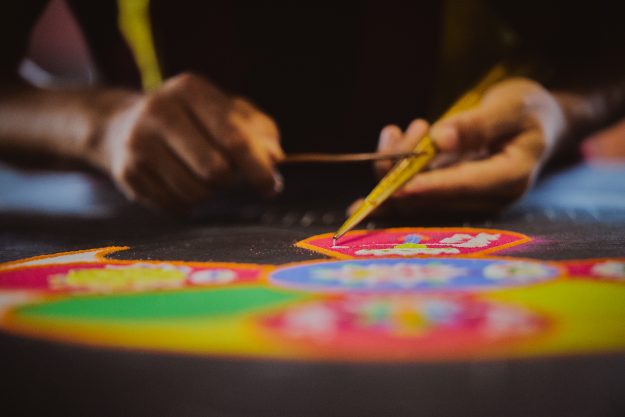 Image courtesy The Pure Land Foundation
Outside, London continued its usual rush: buses crossing the bridge and people hurrying along the river, phones in hand. Yet many of those same busy individuals would step inside, where the monks worked with extraordinary patience, hunched over, placing finely colored sand into a precise pattern that would exist for only a short time.
A mandala is not simply an object to be admired. It is a practice. It asks us to look carefully, to slow down, and to understand that beauty does not become less meaningful because it is temporary.
Each day, the mandala changed. At first, there were only the beginnings of form: outlines, colors, a structure that suggested what might emerge. Then, gradually, the image deepened. Shapes became more intricate. Colors gathered. Visitors who returned more than once could see the progression, not as a sudden transformation but as the result of quiet, repeated attention.
This was one of the most powerful aspects of the installation. It did not demand anything from people. It did not ask them to interpret, perform, or respond in a particular way. It simply invited them to be present. Some visitors stayed for only a few minutes. Others remained much longer, standing in silence, watching the monks work. Many came in from the South Bank, without knowing what they were about to encounter, and left visibly softened by the experience.
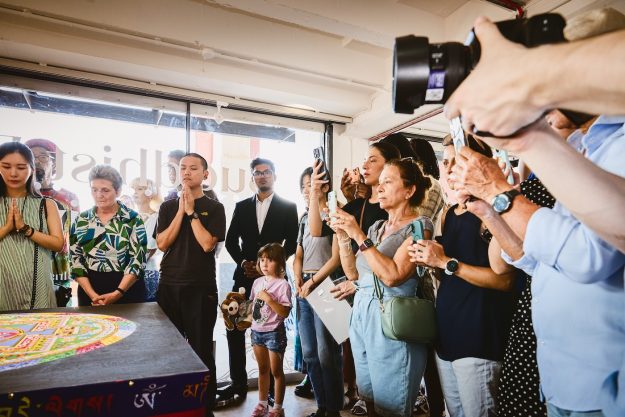 Image courtesy The Pure Land Foundation
At a time when so much of life is shaped by speed, reaction, and distraction, the mandala offered a different rhythm. It reminded us that attention itself can be an act of care. The work of the monks was precise, disciplined, and deeply focused, yet it never felt forced. There was no urgency. There was only the steady accumulation of effort, the kind of effort that is easy to overlook in a world that often values only finished outcomes.
For me, this is where the mandala speaks so directly to contemporary life. Many of the crises we see around us begin inwardly: unresolved anger, fear, resentment, loneliness, the inability to sit with discomfort. We often look outward for solutions, and, of course, society needs action, responsibility, and change. But inner life matters too. The way we respond to the world is shaped by the state of our hearts.
The mandala does not offer a simple answer to suffering. Buddhist practice rarely does. Instead, it offers a way of seeing. It reminds us that everything is changing, that attachment creates pain, and that compassion begins with awareness. Watching the monks work, I was reminded that peace is not passive. It is something cultivated through discipline, patience, and repeated practice.
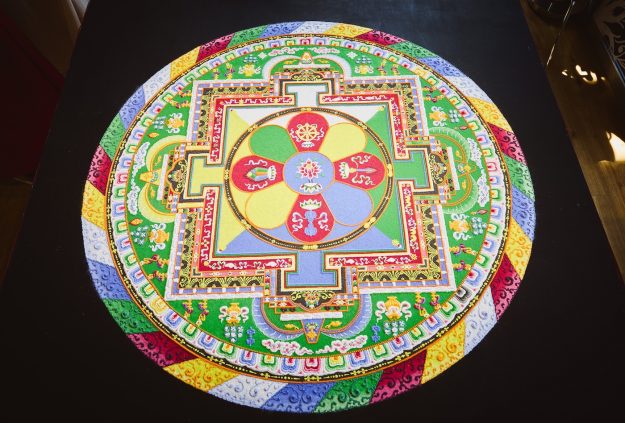 Image courtesy The Pure Land Foundation
Across the five days, the gallery became more than an exhibition space. It became a temporary refuge. Alongside the mandala, evening breathwork sessions invited visitors to experience stillness not only as something observed but also as something felt in the body. The wider program created a bridge between ancient contemplative traditions and the realities of modern urban life: stress, overstimulation, grief, uncertainty, the search for meaning.
The aim was not to preserve wisdom behind glass but to create spaces where people could encounter it directly. Whether through film, culture, meditation, dialogue, or public installations, the question remains the same: How can ancient teachings help us live more consciously today?
The mandala does not offer a simple answer to suffering. Buddhist practice rarely does. Instead, it offers a way of seeing.
The collaboration with Tricycle: The Buddhist Review was especially meaningful in this respect. The organization’s Buddhist Film Festival explores many of these same themes through cinema: impermanence, compassion, identity, suffering, resilience, and transformation. The Oxo installation extended that spirit into the public sphere. It allowed people to encounter Buddhist thought not through explanation alone but through atmosphere, gesture, and experience.
On the final day, Sunday, June 21, the mandala was completed and then ceremonially dissolved. After careful creation, the monks swept the colored sand together, undoing the image that had taken so long to form. It was a beautiful and difficult moment to witness. There is always a part of us that wants beauty to remain. We want to hold on to what moves us. We want evidence that the effort was not lost.
But the dissolution is what gives the mandala its deepest teaching.
Nothing is wasted because nothing remains unchanged. The care, attention, and intention placed into the mandala did not disappear when the image was swept away. They continued in those who witnessed it, in the conversations it created, in the quiet shift it may have brought to someone’s day. The sand was later released into the Thames, carrying the blessing of the work beyond the gallery and into the wider life of the city.
That gesture felt especially powerful on the South Bank. The river has always been a symbol of movement, continuity, and change. To release the sand into the Thames was to acknowledge that the mandala was never meant to belong only to the room in which it was made. Its meaning was always wider than that.
Over the five days, I was struck by how many people seemed to understand this instinctively. They did not need to know every detail of the tradition to feel the importance of what was happening. They recognized patience. They recognized beauty. They recognized the poignancy of something made with devotion and then willingly let go.
Perhaps that is why the mandala remains with us, even after it has disappeared.
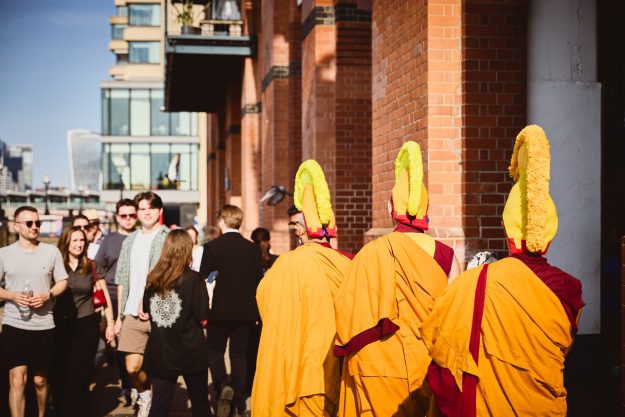 Image courtesy The Pure Land Foundation
It reminds us that the temporary can still be profound. That peace can be created in the middle of a busy city. That spiritual practice does not need to be removed from daily life but can enter directly into it. And that when we learn to let go, we do not lose the meaning of what has passed. We make space for it to move through us, and beyond us, into the world.

Thank you for subscribing to Tricycle! As a nonprofit, we depend on readers like you to keep Buddhist teachings and practices widely available.
This article is only for Subscribers!
Subscribe now to read this article and get immediate access to everything else.
Already a subscriber? Log in.