
 8 months ago
16
8 months ago
16 ARTICLE AD
It’s a story of a garage-born startup turning into a global sportswear force without big budgets or traditional advertising.
As marketers and brand owners, we’ve all seen brands attempt to ride culture, collaborate with influencers, or “build community.” However, very few have operationalized those ideas in the way Gymshark has.
What makes Gymshark’s rise especially relevant to us is that its strategy wasn’t driven by gimmicks. It was built on brand clarity, community belonging, and digital-native marketing discipline.
Below, we break down Gymshark’s marketing strategy and campaigns in a structured, marketer-ready analysis designed to help you understand not just what they did but why it worked and what you can repeat in your own organization.
And more importantly, what can you learn from Gymshark’s playbook?
What’s Inside
Understanding How Gymshark Built a Global Community-Led Brand What Is Gymshark’s Marketing Strategy? Inside the Gymshark Marketing Mix Gymshark Social Media Marketing Strategy Extract Key Lessons Brands Can Apply Today FAQ about Gymshark Marketing Strategy & CampaignsUnderstanding How Gymshark Built a Global Community-Led Brand
These days, whenever we see content about gyms and sports on social media, we also come across the name Gymshark.
Gymshark’s rise is not the result of heavyweight budgets or celebrity endorsements, but an outcome of precision community-building and a deep understanding of how people form identity around fitness culture.
According to the research titled Impact of branding & social media marketing in the digital era: Sports apparel brands, Gymshark grew from a garage startup in 2012 into a global brand valued at $1.4 billion with customers in over 200 countries.
And it did so primarily through digital-first, community-led marketing strategies. This trajectory is rare even among contemporary DTC (direct-to-customers) brands, and it didn’t happen by chance.
As the said research notes, Gymshark’s marketing strategy from day one was to form a “community or family” of athletes and influencers who shared the same fitness aspirations and values as their audience.
The brand’s “About us” page also supports that idea:
We’re Gymshark. We exist to unite the conditioning community.
The statement continues by describing the community as “family” as follows (even though it can be called an outdated term for corporations & companies):
Our Gymshark family of employees, athletes and followers is now over 10 million strong, with a total social media following of over 18 million and customers in over 230 countries across our 14 online stores.
It is also known that Gymshark chose ambassadors (influencers) who already had online “personas” with deeply engaged audiences, so much so that they are not simply posting sponsored content; but reflecting the lifestyle Gymshark wants to represent.
This choice resulted in far deeper customer relationships because followers already trusted these role models.
According to a paper titled A Case Study in Digital Innovation and Community Building Gymshark’s Marketing Strategy, community building & campaigns mean so much for the brand:
If influencer marketing and content strategy are the engines of Gymshark’s marketing, then community engagement is the soul. Gymshark’s rise has been fueled by its ability to cultivate a devoted community of fans and customers who feel personally connected to the brand and to each other. From the outset, founder Ben Francis and his team demonstrated an ‘obsession with customer relationship’ spending extensive time interacting with fellow fitness enthusiasts both online and in person.
Building a large and loyal community for a fitness brand also necessitates creating a social ecosystem. As you already know, Gymshark’s social footprint is enormous, with millions of followers on each platform.
And Gymshark treats them as relationship engines. These platforms are the brand’s biggest stage, featuring ambassadors in real-life gym settings, event clips, training sessions, and transformation posts.
Lastly, user-generated content (UGC), which is regarded as one of the most reliable sources of brand information accessible to consumers today, helps Gymshark develop a community.
What Is Gymshark’s Marketing Strategy?
At its core, Gymshark’s marketing strategy centers on building a community, with authenticity, creator collaboration, and mission-driven content at its heart.
And it now reports a global community of over 10 million customers and more than 18 million social followers across channels, underscoring its cultural reach beyond mere commercial metrics.
These numbers tell us that community over advertising differentiates Gymshark from legacy sports brands and reflects a broader shift toward participatory sports marketing strategies, where consumers are co-creators of brand identity.
To identify the Gymshark brand positioning, differentiating it from other well-known fitness brands, take a quick look at this competitor map:

Speaking of competitors, let’s focus on Nike and Adidas’ marketing strategies for a minute and find out what makes Gymshark so famous these days.
Nike’s marketing strategy historically relies on big storytelling through elite athlete sponsorships (like the Just Do It campaign) and big-budget sports partnerships.
Adidas’ marketing, meanwhile, blends sports performance with lifestyle culture, working through collaborations (like fashion-meets-athletics drops) and celebrity partners, while still maintaining deep performance roots.
In addition to these, Nike and Adidas excel at mass cultural moments like major sporting events, sponsored athletes, and performance campaigns. Gymshark, on the other hand, excels at ongoing fitness community dialogues: micro-stories, participatory content, and creator ecosystems.
So, it’s easy to say that, in contrast to Nike’s big-budget mainstream strategies and Adidas’s hybrid positioning, Gymshark’s strength lies in engagement across fitness communities.
Before closing that section, we need to mention what Gymshark’s campaign culture is. While many other sports brands roll out major seasonal campaigns with coordinated launches and significant paid media activities, Gymshark, by contrast, uses influencer-led buzz campaigns, countdown drops via creator content, and personal storytelling across platforms.
Inside the Gymshark Marketing Mix
Another thing demonstrating how traditional marketing can be reinterpreted for digital-first brands is Gymshark’s marketing mix. Let’s see:
Product:
Several studies on sports marketing commonly show that while performance matters, aesthetic, brand symbolism, and social signaling influence sports apparel consumption. Gymshark products are designed to be worn in gyms and “on social platforms.” That naturally reinforces brand visibility through organic user-generated content.
Limited drops, seasonal launches, and influencer-led product releases increase perceived exclusivity.
Price:
Gymshark occupies a strategic middle ground: premium enough to signal quality, accessible enough for younger consumers.
So, Gymshark’s pricing strategy aligns with research indicating that fitness brands targeting digitally native audiences benefit from aspirational but attainable positioning.
What’s more, the fitness brand avoids heavy discounting that could erode perceived value or undermine its community-driven image.
Place:
Gymshark’s DTC (direct-to-consumer) model is strategic.
By controlling its e-commerce environment, Gymshark owns the full brand experience, from storytelling to checkout.
DTC is identified as a key enabler of modern fitness digital marketing that allows brands to maintain narrative consistency and collect first-party data. And, unlike traditional retail-driven sports brands, Gymshark does not solely rely on physical shelf presence to signal legitimacy. Its legitimacy comes from social proof and community visibility.
Promotion:
The brand’s promotion rarely resembles traditional Gymshark advertising. Instead, it blends content, community engagement, and experiential activations. Product launches are often tied to creator stories, training journeys, or collective moments rather than standalone ad campaigns.
Gymshark’s social media strategy is one of its most powerful growth levers. Unlike many fitness brands that repurpose ads across platforms, the brand treats each platform as a distinct culture and communication ecosystem.
⭐️Platform-native content, tailored for engagement
Gymshark creates content for the platform experience, not for corporate messaging:
Instagram: High-quality aspirational visuals and creator collaborations TikTok: Raw, motivational, trend-aligned short videos YouTube Series: Narrative content that cultivates deeper engagementThis is key for fitness audiences; they feel like they can participate, not just watch.
⭐️Motivation channel, not marketing channel
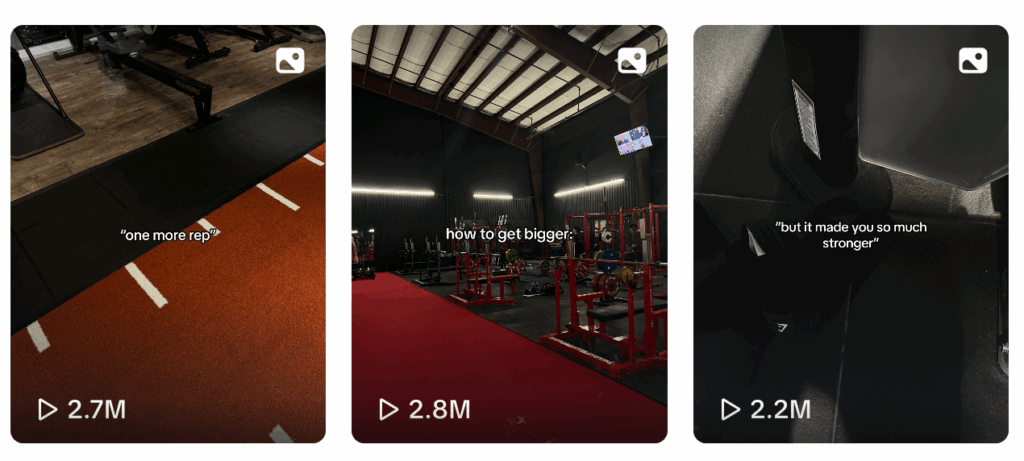
Gymshark social media channels don’t feel like traditional marketing areas. It often operates more like a motivational channel, featuring training clips, day-in-the-life content, humor, memes, and community challenges.
Take a quick look at Gymshark’s TikTok feed, which works like a motivation channel:
⭐️Community engagement as a strategic asset
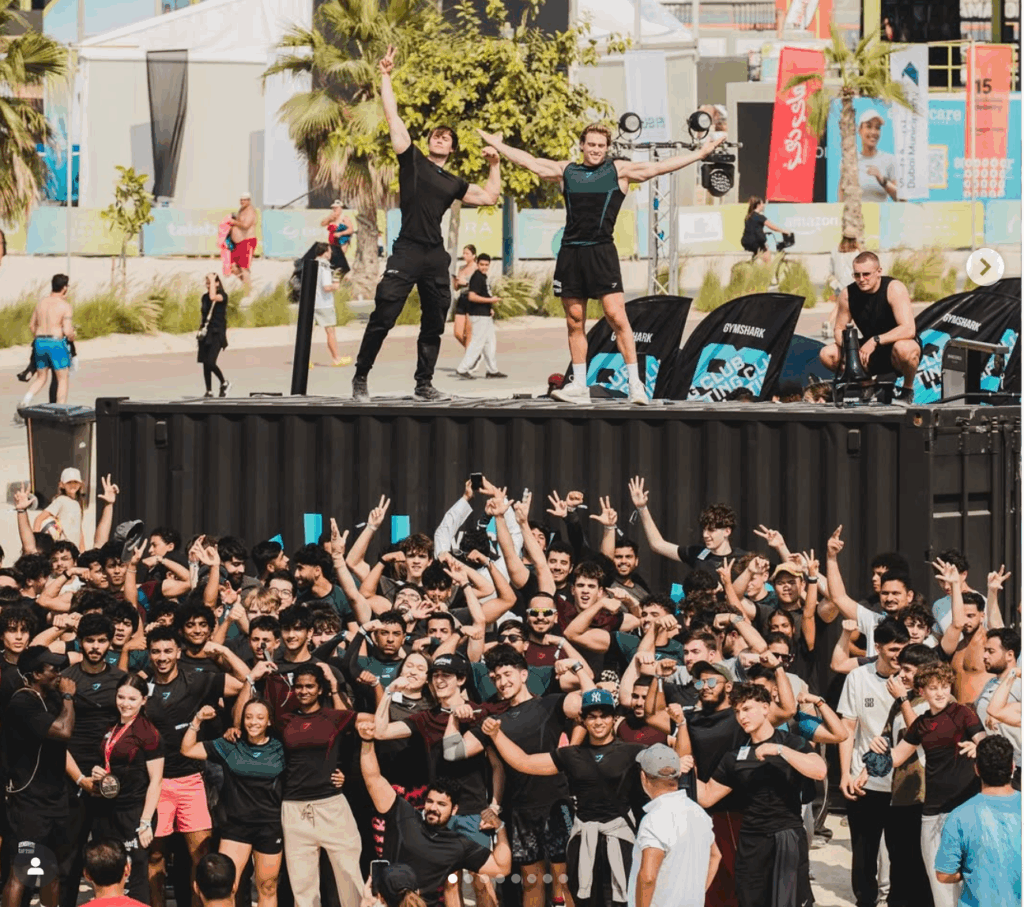
Gymshark’s marketing never treats community engagement as a side tactic. Instead, its entire model depends on community participation.
Source: https://www.instagram.com/p/DQma7R4CDdH/?hl=en&img_index=1
In addition to online meetings and gatherings, the brand creates events where great number of people can attend to.
⭐️Influencer collaborations as long-term partnerships
Gymshark’s influencer marketing approach is another story; real athletes, bodybuilders and wellness coaches.
A prominent example of high-impact influencer collaboration is the partnership with bodybuilding legend Chris Bumstead. Recently re-signed as a Gymshark athlete and even part-owner, Chris brings massive cultural weight to the brand.
His content has been engaging; Bumstead-related social media has been watched tens of millions of times, driving visibility and cultural relevance across bodybuilding, training, and lifestyle audiences.
By aligning with a respected figure in fitness culture (not just a generic celebrity or famous user with a number of followers), Gymshark invests in community identification, amplifying its reach among serious training communities.
Here is another collaboration watched millions of times just on TikTok:
⭐️YouTube’s Train for Life Series
Gymshark is also good at creating YouTube series and influencing millions of people interested in sports.
One standout example of content that fosters loyalty over clicks is the “Train for Life” series.
As you may know, in this format, Gymshark delivers long-form fitness storytelling that goes beyond product features, focusing instead on real journeys, training philosophies, and creative community narratives.
⭐️Investing in social media trends
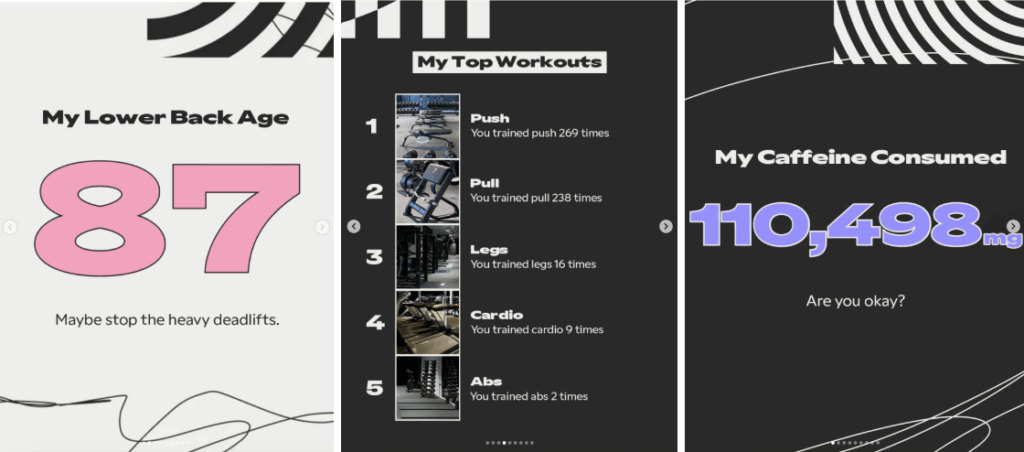
Gymshark’s social media marketing strategy is supported by Gymshark’s ability to identify and adapt platform-native trends at exactly the right moment (not just sports marketing trends, like bucket challenge.)
Rather than creating content in isolation, Gymshark consistently plugs itself into existing cultural moments.
A clear example of this approach is how Gymshark has engaged with Spotify Wrapped–style trend mechanics.
Source: https://www.instagram.com/p/DRznRSZCM39/?hl=en&img_index=1
Extract Key Lessons Brands Can Apply Today
So, yes, when we look closer at Gymshark marketing through a strategic lens, some clear lessons emerge that are highly relevant for today’s fitness digital marketing environment.
One of the most transferable lessons from Gymshark is how closely execution aligns with the Gymshark mission statement: to unite the conditioning community. This mission is not treated as brand decoration; it actively informs content strategy, influencer selection, and campaign formats.Gymshark’s success is inseparable from its deep understanding of the Gymshark target market. The brand does not define its audience purely by age or gender but by mindset: digitally native, community-oriented fitness enthusiasts who value progress, motivation, and relatability over elite athletic status.
Gymshark influencer marketing is effective because it is structural; the brand creates momentum by allowing influencers to showcase products weeks before release, effectively turning each drop into a countdown-driven community moment.
Gymshark extends existing narratives, amplifies community voices, or taps into broader social trends without disrupting the brand experience. This approach reflects a more advanced form of fitness digital marketing, where consistency and cultural participation outperform sporadic high-spend advertising pushes.
Gymshark’s most valuable asset is its community. By consistently spotlighting real people, real progress, and real stories, the brand ensures that its audience feels represented rather than targeted.
For brands looking to replicate this success, the lesson is to adopt Gymshark’s mindset: build systems that allow your audience to become the brand’s most credible voice.
FAQ about Gymshark Marketing Strategy & Campaigns
What is the core Gymshark marketing strategy that helped the brand scale globally?
Gymshark grew globally by putting community and culture before advertising. By setting aside traditional media, the brand focused on social platforms, long-term relationships with fitness creators, and content that resonated with people who train. By staying close to its mission and building with the community rather than marketing at it, Gymshark was able to scale naturally across markets.
How does the Gymshark marketing mix (4Ps) contribute to its strong brand positioning?
Everything in Gymshark’s marketing mix is connected. The products are designed for real training and social visibility, pricing feels premium but still accessible, and the DTC model gives Gymshark full control over how the brand shows up online. Promotion is mostly driven by creators and community content; and it keeps the brand feeling authentic and modern instead of overly commercial.
Gymshark uses social media more like a fitness motivation channel; not a marketing feed like many brands do. Because it sells directly to consumers, it can respond quickly to trends, highlight real customer stories, and experiment with formats without layers of approval. The content feels relevant, timely, and human. So people engage with it instead of scrolling past it.
Which Gymshark marketing campaigns have generated the highest brand awareness?
Forget traditional launches and marketing campaigns: some of Gymshark’s biggest awareness moments have come from creator-led campaigns. Influencer countdowns ahead of product drops, the Train for Life YouTube series, and high-profile partnerships like Chris Bumstead have all driven massive visibility. These campaigns work especially well because Gymshark can convert attention directly into sales through its own platform.
How does Gymshark leverage influencer marketing to drive community growth and sales?
As we stated above, Gymshark uses influencer marketing as a long-term growth engine. Creators are involved well before a product drop, sharing new pieces as part of their real training routines and building excitement over time. This creates trust, strengthens community ties, and naturally drives sales when products finally launch.
What can other brands learn from Gymshark’s integrated marketing strategy?
The biggest lesson is that consistency and authenticity matter more than big budgets. Gymshark shows that when your mission is clear, your target market is well understood, and your creators are treated as partners, marketing becomes more effective. Brands don’t need to copy Gymshark’s tactics, but they can learn from how tightly its community, content, and commerce are connected.