
 1 month ago
4
1 month ago
4 ARTICLE AD
June 06, 2026 We carefully vet all products and services featured on mindbodygreen using our Our selections are never influenced by the commissions earned from our links. An Oura ring has had a near-permanent place on my finger for almost four years now—roughly two with the third generation, and 17 months (and counting) with the Oura Ring 4. The only stretch I’ve taken it off was a two-week honeymoon, and even that felt like cheating on my data. When I first upgraded, my Oura 3 was on its last legs. The battery had started demanding a daily charge, and I’d routinely wake up to blank data where my sleep score should have been. The Oura 4 promised meaningfully better battery life, a redesigned sensor array, and a slimmer, all-titanium build. It also cost an extra $100 and a question I couldn’t shake: is the next generation really worth the upgrade from previous generations, or is this just a glow-up? Nearly two years later, I have an answer—and a lot more data to back it up. Since I made the switch, I’ve worn the Oura 4 through a full pregnancy, labor and delivery, and postpartum recovery. I’ve tested it against the kind of life that smart-ring marketing pages don’t typically show you. Here’s everything I’ve learned, plus the changes Oura has rolled out since launching in 2024 that quietly make the case for an upgrade even stronger. And if you’re wondering about Oura 5, stay tuned. It just arrived at my home, and I’ll update this piece once I’ve tested it for a month. Oura Ring 4 $399 (was $499) The Details
Oura 4
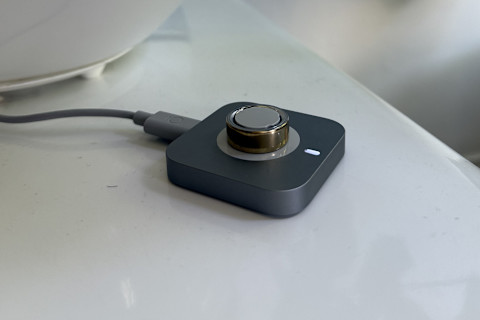
Why I like a smart ring
I’ve never been a watch-or-band person. I don’t like anything on my wrists, so a smart ring felt like the only wearable option for me.
I’m clearly not alone: the smart-ring market hit roughly $417 million in 2025 and is projected to grow at a 22.5% CAGR through 2033. Oura still defines the category, but competitors keep arriving—and that’s a good thing for buyers, because it’s quietly pushed Oura to keep shipping meaningful upgrades to the platform itself, not just the hardware.
Size & fit
Oura sends you a free sizing kit before you order, and it’s worth the wait. The sizes are not identical between generations—my Oura 4 in a size 6 fit slightly looser than my Oura 3 in the same size, but a size 5 was too snug. (If you’re between sizes, you can’t currently split the difference; half-sizes are on the wish list, and several people on my team have said the same.)
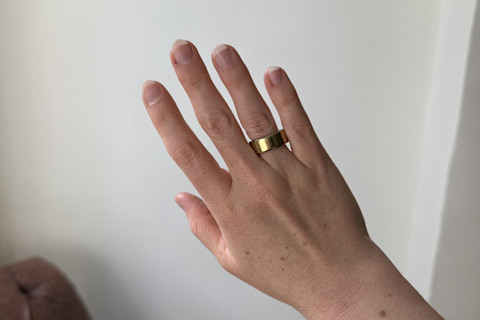
Image by mbg Creative / Hannah Margaret Allen
Oura recommends the pointer finger because it has larger blood vessels that are easier for the sensors to read. However, the most important factor is a ring that actually fits the base of your finger. In fact, insider intel from the Oura team reveals that your pointer, middle, and ring finger are all safe options. Your index finger will be the most accurate, but it’s a minimal difference. A huge relief for me, as I like the look of it on my ring finger best.
Does Oura 4 feel different than Oura 3?
The big design change is the move to a fully titanium build, inside and out. (Oura 3 had a titanium exterior with an epoxy-resin interior.) I expected the new ring to feel colder and more metallic, but it doesn’t. After a day on the finger, I forget I’m wearing it.
The flat sensors are the standout. Oura 3’s interior had small raised domes—you could feel them if you went looking. Oura 4’s sensors are recessed (0.3mm below the surface, versus the 1.3mm domes on Oura 3), which means the interior is essentially smooth. It looks better, it feels better, and it reads better.
I went with gold in both generations. The Oura 4 gold is a slightly different tone than my old Oura 3, though I suspect that’s mostly because my Oura 3 spent two years getting beautifully dinged-up. Both versions scratch and dull over time, but if that bothers you, smart rings probably aren’t your thing. I genuinely prefer how mine looks after a few months of wear.
Major data & battery improvements
Here’s the test I always come back to: Oura 3 used to think washing my hair was a HIIT workout. (In fairness, washing long hair is a workout—but it’s not exactly Tabata.) Doing the dishes? Also, a HIIT workout, according to Oura 3.
Oura 4 doesn’t make that mistake. The redesigned interior adds more sensor coverage around the inside of the ring (18 signal pathways versus eight in Oura 3), resulting in better signal capture and less misread movement. The ring is also less affected by the small rotations every ring makes on the finger during the day. On Oura 3, the central sensor could drift off-center and produce gaps in the data; on Oura 4, I almost never see that.
The upshot is that subtle, real activity finally registers as itself. A cat nap looks like a nap. A round of housework looks like housework. “Exercise snacks”—aka breaking your movement into a few minutes here and there—actually get logged. I did seven minutes of squats and pushups one morning, and the ring caught it, no manual tagging needed.
The sleep data is more granular, too. The stages (REM, deep, light, awake) feel sharper, and the timing feels closer to what I’d self-report. After 17 months, I trust the trends. That’s a big deal for a metric like HRV, where the only thing that matters is being able to compare today against your own baseline.
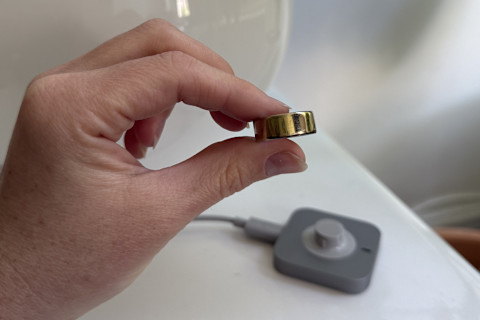
The biggest upgrade was the battery improvements.
By the end of my Oura 3’s life, I was charging it daily—and still occasionally losing a night’s worth of data because the battery couldn’t last the night. It was frustrating. HRV is my favorite stat, and missing readings during a stressful week was exactly when I needed it most.
The Oura 4 charges roughly once a week. I plug it in while I work at my desk for an hour and forget about it until the next time. Even when it’s running low, I’ve yet to have a night where I lost sleep data. After almost a year and a half, the battery still behaves like new, and I’m cautiously hopeful that the all-titanium build will hold up longer than the Oura 3 did over time.
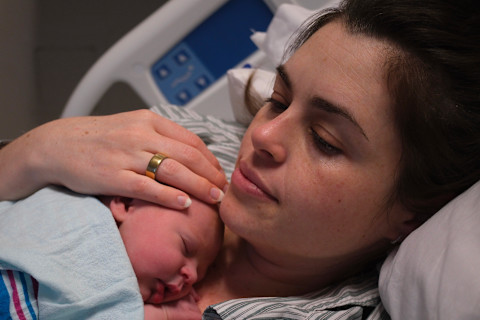
Image by mbg Creative / Hannah Margaret Allen
My experience during pregnancy & postpartum
The most surprising thing about my time with the Oura 4 is that I wore it through my entire pregnancy. The third trimester swelling didn’t come for me, and I was able to keep the ring on and the data continuous through labor, delivery, and into postpartum. That continuity ended up mattering more than I anticipated.
A few moments from that stretch:
HRV predicted the start of labor. My average HRV in the third trimester ran around 57. In the weeks leading up to my due date, I was checking it religiously, hoping for some physiological tell that things were close. The morning I started early contractions, my HRV had dropped to 37. Anecdotally, plenty of pregnant Oura wearers have noticed similar dips in the days before labor; a 20-point single-day swing on my own baseline was the most obvious signal my body sent me that something was changing.
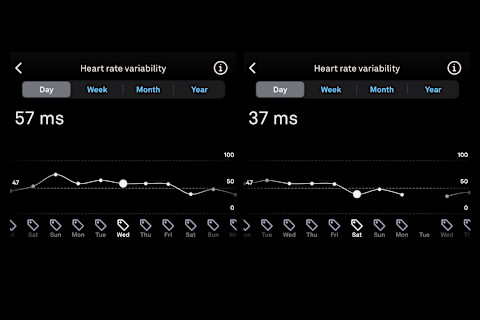
Image by mbg Creative / Hannah Margaret Allen
The sleep data made postpartum survivable. My doula told me that most new parents need about six hours of sleep to function—and that those hours don’t have to be consecutive. With a newborn waking every two to three hours, my sleep scores cratered (unsurprisingly), but the total time asleep number turned out to be the metric I actually needed. I could see at a glance whether I’d hit that six-hour mark in fragmented pieces and adjust my day accordingly. While it may sound disheartening or like it's not enough sleep (it's not), I genuinely found it useful.
Postpartum recovery had a real signal. Easing back into movement is one of the more delicate parts of postpartum, and watching my readiness, resting heart rate, and HRV respond to it gave me a feedback loop. I could see when my body was telling me to push and when it was telling me to back off.
A note on what Oura has built since I first drafted this: the platform now includes a dedicated Pregnancy Insights mode, which adjusts your Readiness, Sleep, Rest Mode, and Recovery Mode scoring to account for gestational age. It tracks temperature trends, resting heart rate, HRV, and respiratory rate as the four pregnancy-relevant biometrics, and it lets you tag symptoms and physical changes against the data.
What’s new since Oura 4 launched
If you’ve been on the fence since the ring came out in October 2024, the case for upgrading is stronger now than it was at launch. A few additions worth knowing about:
The subscription conversation
The subscription cost is the question I get most often, so it’s worth addressing head-on. Oura membership is $5.99/month or $69.99/year after a one-month free trial, and almost everything in the app sits behind it: detailed sleep analysis, 24/7 heart rate, skin temperature, SpO2, stress, cycle tracking, the Advisor.
Without it, you have a $349 ring and a very basic dashboard. With it, you have what the marketing pages promise.
Whether that’s fair pricing depends on what you think you’re paying for—a piece of jewelry, or a service. I treat it like a service, and I find the price-per-insight reasonable. Your math may differ.
(In full transparency, I was gifted a 2-year membership with my device, but I would absolutely pay the monthly fee.)
Oura Ring 5 vs 4 vs 3
Oura Ring 5
Oura Ring 4
Oura Ring 3
The takeaway
If you’re an Oura 3 wearer who’s started seeing battery degradation, the upgrade is an immediate quality-of-life win—you stop losing data, you stop charging daily, and the sensor accuracy is a real improvement, not a marketing one. If you’re a first-time smart-ring buyer, the decision is mostly made for you: Oura 3 is no longer sold new through Oura, and at this point, you can buy Oura 4 or 5. We can't recommend Oura 5 yet without giving it some time, but again, that test is in progress. Come back in four weeks for more info.
In the meantime, it's a question of whether you want a daily relationship with your own biometric data. After almost four years of wearing one—including the most physiologically eventful year of my life—I can say that I do, and I will. I’ll be sticking with my Oura.