
ARTICLE AD
Have you ever wondered what the subtle body truly is, and how it differs from the causal body?
Most people come to yoga through the body. A tight back. A stressed mind. A recommendation from a friend.
But yoga teaches something deeper. Your body is just the outer layer of who you are.
Beneath it are four more layers, each more subtle than the last. Together, they shape how you feel, think, and experience life.
These layers are called the koshas.
Understanding the koshas doesn’t just deepen your yoga practice. It helps you make sense of your energy, your emotions, your thoughts, and even those quiet moments of peace that seem to come from nowhere.
In simple terms, the koshas are a map of the human experience.
First described in the Taittiriya Upanishad, this model is still highly relevant today, especially for anyone looking to go beyond the physical side of yoga.
What Are the Koshas?
In Sanskrit, kosha means “sheath” or “covering.”
You can think of them like layers of an onion, or Russian nesting dolls- each layer holding something deeper inside.
The five koshas surround your innermost self, known in yogic philosophy as the Atman– the unchanging awareness at your core.
From outermost to innermost, the five koshas are:
Annamaya Kosha — the physical body Pranamaya Kosha — the energy or breath body Manomaya Kosha — the mental and emotional body Vijnanamaya Kosha — the wisdom or intellect body Anandamaya Kosha — the bliss bodyThese layers are not separate. They constantly interact and influence each other.
For example:
When your energy is low, your thinking becomes unclear When your mind is anxious, your breath becomes shallow When your body is tense, your emotions feel heavierThe koshas help you understand these connections.
They give you a simple way to see where imbalance starts and how to bring yourself back into balance.
The Atman: What the Koshas Are Covering
At the centre of all five koshas is the Atman, often translated as the true self.
In simple terms, the Atman is the part of you that does not change.
It is not your body, your thoughts, or your emotions. It is the awareness behind all of them.
In yogic philosophy, the Atman is described as:
Constant and unchanging Free from stress, fear, and fluctuation Present through every state of lifeWhether you are awake, dreaming, or in deep sleep, this awareness remains.
The ancient Upanishads describe it as the silent witness always present, but untouched by what is happening on the surface.
You can think of it like this:
Your thoughts change. Your body changes. Your emotions rise and fall.
But something in you stays the same, quietly observing it all.
That is the Atman.
Why This Matters in Yoga
The koshas are the layers that cover this inner awareness.
When you feel stressed, tired, or confused, it is usually happening in one of the outer layers – the body, breath, or mind.
Yoga is the process of moving inward through these layers, not to “create” peace, but to uncover what is already there.
Key Qualities of the Atman (Simple Understanding)
In traditional texts, the Atman is described as:
Pure awareness – the ability to observe Unchanging – not affected by time or experience Independent – not dependent on the body or mind Whole – complete in itselfThese are not ideas to believe, but something to experience through practice. point to the absolute nature of Atman, which remains untouched by time, space, or change.
Relation Between Koshas and Atman
Kosha means “sheath” the layers that cover the Atman. The Atman, or soul, resides at the core of the Anandamaya Kosha (the fifth sheath), which is described later in this article.
The Atman is distinct from the five koshas. Just as smoke, which arises from fire, can conceal the fire, the koshas though dependent on the Atman for their existence veil the presence of the Atman. Yet, it is the Atman that illuminates and pervades them all.
In Ayurvedic and philosophical texts, two types of relationships are described:
Samavaya relation – An inseparable relationship Samyoga relation – A temporary or separable connectionSamavaya is discussed in Padarth Vigyan (the science of matter) as the inseparable bond between a subject and its inherent qualities. However, there is no Samavaya relationship between the Atman and the koshas.
Samyoga describes a separable relationship, like that between a drum and a stick. But even this cannot apply to the Atman and the koshas, because the Atman is not composed of the five elements or physical matter.
The relationship between Atman and the koshas is only the Adhyasa (illusory or superimposed).
Human personality & concept of koshas
Guhāhitaṁ Brahma yat tat pañcakośa vivekataḥ, boddhuṁ śakyaṁ tataḥ kośa pañcakaṁ pravi vicyate
This verse refers to Brahman hidden in the cave of the heart, which is to be understood through the discrimination of the five koshas.
The human personality is a blend of physical, mental, and spiritual aspects. It includes patterns of thoughts, emotions, behaviours, social interactions, values, and attitudes that shape one’s self-perception and life experience.
According to the Upanishads, the Purusha (the Self or inner being) exists in terms of:
Three bodies (Sharira-traya) – gross, subtle, and causal Five sheaths (Pancha Koshas) – layers that cover the SelfThese layers help explain how the Self expresses through different levels of human existence, from the physical to the blissful.
Historical background
The Taittiriya Upanishad describes the human being as having a five-sheath personality (Pancha Kosha), which corresponds with the concept of Sharira Traya the three bodies. The Triguna Theory: Ancient Indian philosophy explains that personality can be refined through tapas (austerity) and value-based education, guided by the concept of the three gunas—Sattva, Rajas, and Tamas. These gunas bind the soul to the material world and influence mental and emotional tendencies.. Principles from Sankhya Philosophy: According to Sankhya philosophy, there are two eternal principles: Purusha – Conscious, intelligent, and inactive Prakriti – Unconscious, non-intelligent, and activeThese two are interconnected and together give rise to the formation of the Sharira Traya (three bodies), which will be explained further in this article.
In Ayurvedic texts, personality is also classified into 16 types based on the gunas 7 Sattva, 6 Rajas, and 3 Tamas types. These classifications describe dominant traits and temperaments in individuals.The theory of Pancha Koshas, as mentioned in the Taittiriya Upanishad, offers a Vedantic psycho-philosophical framework to understand human personality across physical, mental, and spiritual dimensions.
Pancha-kosha: 5 Layers to the self
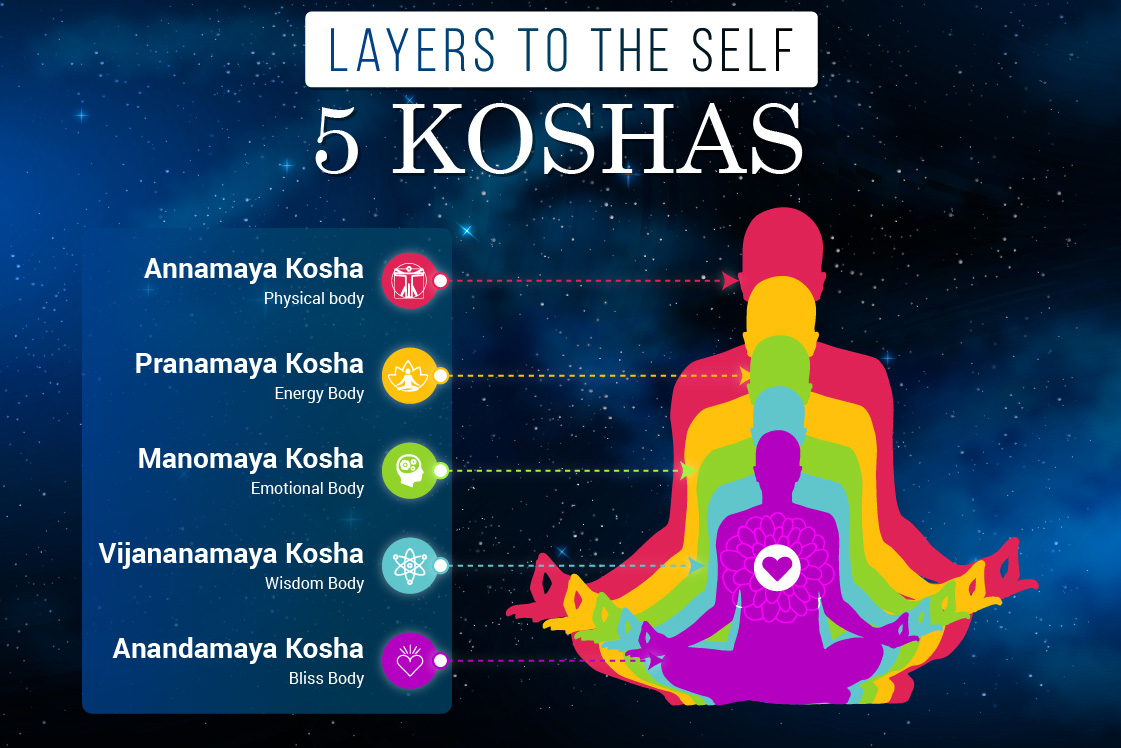
In Sanskrit, Kosha means “sheath” or “covering.” Koshas are understood as layers through which awareness flows—from the outer body toward the inner Self and thus cover the Atman.
Pancha Kosha refers to the concept in yogic philosophy that there are five layers or sheaths surrounding the human soul. These layers also represent the five aspects of human personality.
Much like the chakra system, the five koshas are arranged one within the other from the outermost physical layer to the innermost sheath of bliss. These five layers exist across the three bodies (Sharira Traya) known as the gross, subtle, and causal bodies.
The ancient view of “personality” or “body constitution” is structured through these five sheaths:
Annamaya Kosha Pranamaya Kosha Manomaya Kosha Vijananamaya Kosha Anandamaya Kosha1. Annamaya Kosha(physical sheath)
Annamaya comes from Anna (food) and Maya (made of). This sheath represents the physical body, which is nourished by food and composed of the five elements earth, water, fire, air, and space. It is associated with the Root Chakra and the earth element.
This sheath is dominated by Tamo Guna, and it is perishable, having both a beginning and an end.
In yoga, physical postures (asanas) help strengthen and balance the Annamaya Kosha.
This sheath arises from the union of Shukla (male seed) and Sonita (female seed), and continues its development through nourishment from food. Even semen, as per Ayurvedic understanding, is a by-product of food synthesis.
The Annamaya Kosha forms the base of personality, influencing one’s physical, emotional, and social traits, and it undergoes the six modifications (Shad Bhava Vikara):
Birth Existence Growth Change Decay DeathMethods to purify and develop this sheath include:
Upavas (fasting) Asanas (Yogic postures) Tatvashudhi (Inner Purification) Tapashcharya (Practice of austerity). Letting our soul free from worldly attachments from the physical body are the first objective of spirituality. (3)The first step in spirituality is to detach the soul from the identification with this food sheath. Most modern medicine primarily acts on this layer.
2. Pranamaya kosha (vital energy sheath)
Pranamaya refers to the sheath made of prana, the life force. It includes the five major pranas, which sustain the physical body and serve as a bridge to the mental layer (Manomaya Kosha).
This kosha is influenced by Rajo Guna, indicating dynamic activity. Though more subtle than the physical body, it too is perishable and has a beginning and an end.
In yoga, pranayama (breathing techniques) and asanas regulate this sheath. Prana originates from Moola Prakriti the Divine Mother or root of nature.
3. Manomaya Kosha (mental sheath)
The Manomaya Kosha is made up of the mind and is nourished by thoughts and sensory impressions. It plays a vital role in processing emotions, desires, and interactions with the world.
This sheath includes the gyanendriyas (sense organs) and karmendriyas (organs of action), which help us perceive and act upon the outer world:
Gyanendriyas are the five sense organs; eyes (vision), ears (hearing), nose (smell), tongue (taste), and skin (touch)—through which we perceive objects. Karmendriyas are the organs of action that allow us to respond to the environment, such as hands, feet, mouth (speech), reproductive organs, and organs of excretion.The Manomaya Kosha is formed by a combination of Sattva guna (purity) and Tamo guna (inertia). It is perishable in nature—meaning it has a beginning and an end.
This kosha acts as the mental faculty that receives sensory signals, interprets them as positive or negative, and then develops desires—mainly aspiring for what is perceived as positive.
The primary functions of the Manomaya Kosha include:
Sankalpas – interpreting intentions and preparing the mind to act accordingly. Vikalpas – rejecting negative or undesirable thoughts and actions.The mind holds certain traits known as Vrittis like lust, anger, greed, and more. These Vrittis cause the thoughts in the mind to constantly fluctuate, which is why the mind is called Vikari (subject to change).
In contrast, the Atman our true Self is Nirvikara, meaning it is unchanging and beyond all modifications.
The mind, along with the five sense organs (tongue, nose, eyes, ears, and skin), forms the Manomaya Kosha, also called the mind-sheath.
Various aspects of yoga practice influence this kosha. For example:
Meditation calms the restless mind. Alternate nostril breathing (Nadi Shodhana) balances mental energy and improves clarity.4. Vijnanamaya Kosha (wisdom sheath)
The Vijnanamaya Kosha, or intellectual sheath, is made up of vijnana, which means intellect or wisdom. This kosha is closely linked to the throat chakra and governed by the air element, representing clarity, expression, and understanding.
It comprises the intellect (buddhi) along with the five sense organs, and governs deeper mental functions such as willpower, discrimination, and decision-making. It is nourished by the ego and shapes our ability to analyse, judge, and respond consciously to life experiences.
This sheath functions even in the deep sleep state, where pure intelligence reflects as Chidabhasa the subtle reflection of consciousness in the intellect.
Although subtle, the Vijnanamaya Kosha depends on the more external sheaths (like the body and breath) for its functioning. In yogic philosophy, meditation is the key practice to purify and transcend this sheath, allowing one to move closer to the inner self.
5. Anandamaya kosha (bliss sheath)
Ananda means a state of deep joy or bliss. In Advaita Vedanta, the Anandamaya Kosha is the innermost sheath and is closest to the soul (Atman). Because of this close connection, it naturally reflects the joy that comes from the soul.
This sheath is connected to emotions and consciousness. It belongs to the causal body and is often seen as the layer where the soul expresses itself. The Anandamaya Kosha is not limited by thoughts or actions. It is felt most clearly during deep sleep, where the mind is quiet and the person experiences peace without knowing it.
This kosha expresses three beautiful qualities of the soul:
Sat – Truth and eternal being Chit – Consciousness or awareness, the quality that shows something is alive Ananda – Pure joy or happinessThe Anandamaya Kosha is the most subtle of all five koshas. It can only be felt when the mind is calm and the other sheaths are balanced. Bliss comes not from outside but from the deep connection with our inner self.
5 Koshas lies in three bodies (sharira traya)
The five koshas (sheaths) that shape human personality are not separate from our body but exist within three levels of our being, called the Sharira Traya the Gross Body, Subtle Body, and Causal Body. Each kosha finds its place within these three bodies and reflects a specific layer of our existence.
1. Sthula Sharira/ Gross Body
The gross body is the physical body underlined with the sheath of Prana – the vital air. It’s the product of 5 Gross Elements (Earth, Water, Fire, Air, Space). This body is Subject to 6 changes (Existence, Birth, Growth, Change, Decay & Death). Physical medium to experience pain & pleasure. Contains the body in Seed form in Waking State (Jagrata Avastha) viz Mind is fully Functional (purna vikasah).2. Linga Sharira/ Subtle or Astral Body
The subtle body is the vital energy field for balancing mental and intellectual state. It contains Pranamaya Kosha (sheath of prana), the Manomaya Kosha (sheath of mind), and the Vigyanmaya Kosha (sheath of intellect). Product of 5 Subtle Elements 5 Organs of Perception (jnanendreiya) & 5 Organs of Action (karmandreiya) 5 Vital Forces (prana) Contains the Body in Seed form in Dream State (Svapna Avastha) in which mind is partially Functional (Ardha vikasah).3. Karan Sharira/ Casual Body
Karana Sharira or Causal body is the map template which is the sole cause for the gross and subtle bodies.
The causal body manifests the ego. Anandmaya Kosh (sheath of bliss) resides in the Causal body (Karana Sharira). It defines the state of Ignorance (avidya), Indescribable, Beginningless Contains the Body in Seed form in Dream-less Deep Sleep (sushupti – Nitya pralaya) i.e. Mind is almost Non-Functional (avikasah). Karta and bhokta viz the doer and the enjoyer, designate the intellectual sheath and the causal sheath. In the causal sheath, there is a balancing of the properties of Nature (Prakriti)—sattva, rajas, and tamasConclusion
The five koshas offer a simple but powerful way to understand yourself — not just as a body, but as layers of energy, mind, awareness, and inner stillness.
From the physical body (Annamaya) to the bliss layer (Anandamaya), each sheath plays a role in how you experience life.
But yoga is not about getting stuck in these layers. It is about moving through them.
As you practice, you begin to shift:
from tension in the body → to ease from restless thoughts → to clarity from effort → to quiet awarenessAnd in those quiet moments, you start to sense something deeper- a steady presence that does not change.
That is the Atman.
The journey of yoga is not about becoming something new.
It is about recognising what has always been there, beneath every layer.
FAQs
1. What are the 5 koshas in yoga?
They are five layers of the human system: physical body, energy body, mental body, wisdom body, and bliss body.
2. How do koshas relate to mental health?
The mental (Manomaya) and energy (Pranamaya) koshas play a big role in stress, anxiety, and emotional balance. Practices like breathwork and meditation help regulate them.
3. Can anyone access the bliss body (Anandamaya Kosha)
Yes. Most people have glimpsed it in moments of deep peace, flow, or profound love. The practice is less about achieving something new and more about clearing the obstructions in the other four layers so this natural quality can surface more consistently.
4. Are the koshas the same as the chakras?
No, though they overlap and interact. Chakras are energy centers located along the spine within the subtle body. The koshas are the broader layers of being within which the chakras operate. Both are frameworks for understanding the subtle architecture of the human being.
5. How do I work with my koshas in daily practice?
Each kosha has specific practices: asana and nutrition for the physical body, pranayama for the energy body, meditation and mantra for the mental body, self-inquiry and study for the wisdom body, and selfless service or devotion for the bliss body. A well-rounded yoga practice naturally touches all five