 1 day ago
1
1 day ago
1 ARTICLE AD
QUICK ANSWER
Pranayama (प्राणायाम) is the yogic science of breath control and conscious regulation of prana (life force energy). The word combines “prana” (vital breath) and “ayama” (expansion/regulation). Pranayama techniques involve deliberate patterns of inhaling, exhaling, and breath retention to regulate the nervous system, calm the mind, and balance vital energy throughout the body. Practiced consistently, pranayama reduces anxiety, improves sleep, enhances focus, and prepares the mind for meditation.
Breathing is something your body does automatically — 20,000 times per day, without any conscious effort from you.
But what if that most automatic of functions was also the most powerful tool you have for changing your mental state, calming your nervous system, and accessing deeper states of awareness?
This is what Pranayama Yoga reveals: breathing is not just a biological necessity. It is a mechanism for direct control over the autonomic nervous system, the energy body, and the quality of consciousness itself.
While most modern people are vaguely aware that “deep breathing” is calming, the actual science and systematic techniques of Pranayama go far deeper. Different breathing patterns activate different neurological and energetic responses. Some pranayama techniques are energizing. Others are deeply calming. Some are designed for mental clarity. Others for spiritual awakening.
This complete guide walks through:
The science of how pranayama works in your brain and body The eight fundamental pranayama techniques — how to practice each one The specific benefits of each technique and when to use it Step-by-step instructions for safe, effective practice How to integrate pranayama into your daily life for lasting transformationWhether you’re struggling with anxiety, trying to improve your sleep, seeking to deepen your meditation practice, or simply curious about the yogic science of breath — Pranayama Yoga is the doorway to one of the most practical and powerful tools in the yoga tradition.
Ready to harness the power of your breath? Let’s begin.
WHAT IS PRANAYAMA YOGA? THE SCIENCE OF BREATH & PRANA
Pranayama (प्राणायाम) is the fourth limb of Patanjali’s eight-limbed yoga path — the systematic practice of breath regulation and the conscious direction of prana (life force energy) through the body.
The word breaks into two Sanskrit components:
Prana = Life force, vital breath, animating energy Ayama = Extension, expansion, regulation, controlTogether, Pranayama means “the expansion and regulation of vital life force through conscious breath control.”
Why Breathing Matters in Yoga Philosophy
In the classical yoga tradition, the breath is understood as the bridge between the physical body and the energetic/mental dimensions of consciousness. The breath is visible and controllable (unlike most energy), yet directly influences the invisible domains of mind and spirit.
When your breath is rapid and shallow, your nervous system remains in a state of slight activation — ready to respond to threat. Your mind is restless. Your energy is scattered. Your capacity for deep awareness is limited.
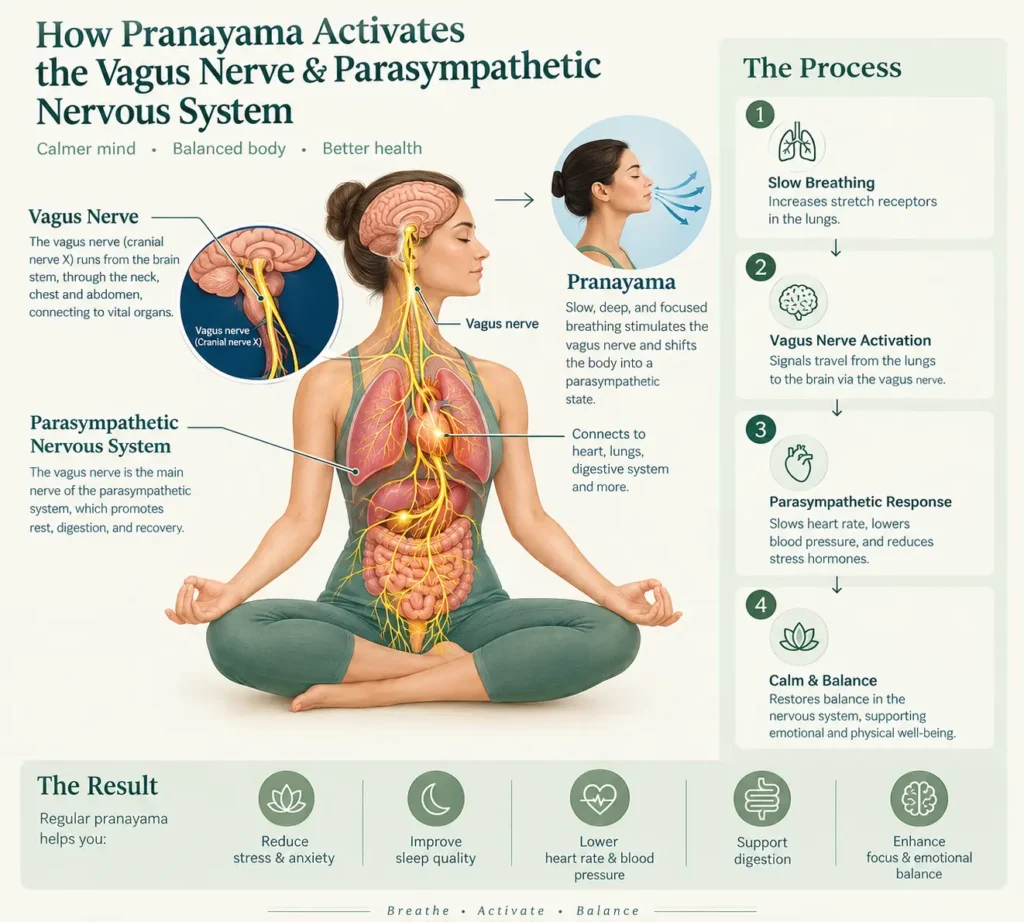
When your breath is slow and deep, your nervous system shifts into a parasympathetic (rest-and-digest) state. Your mind settles. Your energy becomes coherent. Meditation becomes naturally accessible.
Pranayama systematizes this relationship — using specific breathing patterns to deliberately shift your nervous system state, regulate your vital energy, and prepare your mind for the deeper meditative practices of yoga.
The Physiology: How Pranayama Actually Works
Modern neuroscience has validated what yoga practitioners have known for thousands of years:
The Vagus Nerve Connection: The vagus nerve is the master switch of your parasympathetic nervous system. It regulates heart rate, digestion, immune function, and emotional state. Slow, extended exhale breathing directly stimulates vagal tone — essentially activating your body’s natural relaxation response.
Heart Rate Variability: Pranayama practices that extend the exhale (like 4:8 breathing) increase heart rate variability (HRV) — a marker of nervous system flexibility and resilience. Higher HRV correlates with better stress management, improved immune function, and greater emotional regulation.
CO2 and Brain Chemistry: Different breathing patterns change blood CO2 levels, which directly influence blood flow to the brain, oxygen availability at the cellular level, and the production of neurotransmitters associated with calm (GABA), focus (dopamine), and mood regulation (serotonin).
Energetic Anatomy (Nadis and Chakras): Yoga philosophy describes 72,000 subtle energy channels (nadis) throughout the body, with three primary channels: Ida (lunar, cooling, left nostril), Pingala (solar, heating, right nostril), and Sushumna (central channel). Pranayama practices deliberately activate and balance these channels, moving energy through the body in specific patterns to achieve desired effects.
Pranayama vs. Simple Deep Breathing
While taking a deep breath is calming, Pranayama is far more specific and potent than casual deep breathing:
| Structure | Unstructured, random | Precise patterns (ratios of inhale/exhale/retention) |
| Duration | Occasional | Sustained daily practice (20+ minutes) |
| Specificity | General calming | Targeted effects (energizing, cooling, focusing, grounding) |
| Technique | Simple — just breathe deeply | Sophisticated — involves nostril alternation, breath locks, visualizations |
| Results | Temporary calm | Cumulative nervous system retraining over weeks/months |
| Preparation | None | Requires proper alignment, posture, and teaching |
Deep breathing is useful. Pranayama is transformative.
Origins and History of Pranayama Yoga
The practice of Pranayama dates back thousands of years to the ancient yogic texts known as the Vedas. The concept of controlling the breath was introduced in the Upanishads and the Yoga Sutras of Patanjali, which are the cornerstone texts of classical yoga philosophy. Patanjali, in his Yoga Sutras, outlines the importance of Pranayama as a means of controlling the fluctuations of the mind and achieving higher states of consciousness.
Over time, Pranayama yoga evolved with different schools of thought and techniques. Today, Pranayama is practiced by millions worldwide for its vast health benefits.
NINE BENEFITS OF PRANAYAMA YOGA
Benefit 1: Activates the Parasympathetic Nervous System (Stress & Anxiety Relief)
Pranayama practices with extended exhales (like Ujjayi or Nadi Shodhana) directly activate the vagus nerve — the main control switch for your parasympathetic (rest-and-digest) nervous system. Within minutes of practice, cortisol (stress hormone) decreases, heart rate slows, and mental chatter quiets. People practicing pranayama daily report 30-50% reduction in anxiety symptoms within 2-4 weeks.
Benefit 2: Improves Sleep Quality & Reduces Insomnia
Pranayama practiced 10-15 minutes before bed shifts your nervous system into the optimal state for sleep onset. The calming effect extends into the night, improving sleep depth and reducing nighttime waking. Breath ratio practices like 4:8:4 (4-count inhale, 8-count exhale, 4-count retention) are particularly effective for insomnia because they lower arousal while maintaining awareness.
Benefit 3: Enhances Mental Clarity & Cognitive Function
Specific pranayama techniques (like Kapalabhati and Bhastrika) increase oxygenation to the prefrontal cortex — the brain region responsible for executive function, decision-making, and focus. Practitioners report improved concentration, faster mental processing, and enhanced problem-solving ability within hours of practice.
Benefit 4: Boosts Energy & Vitality (When Needed)
While some pranayama techniques are deeply calming, others (like Bhastrika and Kapalabhati) are energizing. These heating pranayamas increase metabolism, stimulate the nervous system, and move stagnant energy — ideal for afternoon fatigue or low motivation. Unlike caffeine, this energy is stable and without crash.
Benefit 5: Regulates Emotions & Mood
Pranayama directly influences neurotransmitter production. Slow breathing increases GABA (calming) and serotonin (mood regulation). Faster breathing increases dopamine (motivation). By choosing specific pranayama techniques, you can deliberately influence your emotional state in a way that is both immediate and cumulative.
Benefit 6: Improves Respiratory Health & Lung Capacity
Pranayama strengthens the respiratory muscles, improves oxygen uptake efficiency, and increases lung capacity. People practicing pranayama show measurable improvements in pulmonary function tests, respiratory endurance, and oxygen saturation. This is particularly beneficial for athletes, singers, and people with respiratory limitations.
Benefit 7: Balances the Nervous System Long-Term
Unlike single breathing exercises that provide temporary relief, consistent pranayama practice over weeks and months actually retrains your nervous system at a deeper level. Your baseline activation decreases. You become less reactive to stress. Your capacity to remain calm under pressure increases significantly.
Benefit 8: Purifies & Moves Stagnant Energy (Prana Circulation)
In yoga philosophy, pranayama clears blockages in the energy channels (nadis) and moves prana freely through the body. Practitioners report feeling more “alive,” having more physical vitality, reduced chronic tension, and improved immune function — all attributed to enhanced prana circulation.
Benefit 9: Prepares the Mind for Meditation
Pranayama is the essential preparation for the inner limbs of yoga (Dharana — concentration, Dhyana — meditation, Samadhi — absorption). A calm, steady mind that has been regulated through pranayama naturally settles into meditation far more easily than an untrained mind. This is why pranayama precedes meditation in the classical yoga path.
RESEARCH & STATISTICS
Anxiety reduction: 30-50% decrease in anxiety symptoms with 4 weeks daily practice (Journal of Alternative and Complementary Medicine, 2017) Cortisol decrease: 15-25% reduction in stress hormone within 10-15 minutes of practice (Psychoneuroendocrinology, 2018) Heart rate variability: 20-30% improvement in HRV (nervous system resilience) after 8 weeks consistent practice (Frontiers in Psychology, 2019) Sleep improvement: 40-60% improvement in sleep onset latency and sleep quality (Sleep Health, 2020) Lung capacity: 15-20% increase in forced vital capacity (FVC) after 12 weeks practice (International Journal of Yoga, 2019) Blood pressure: 8-12 mmHg reduction in systolic blood pressure with regular pranayama (Hypertension Research, 2018) Brain wave activity: Increased alpha and theta waves (associated with calm focus) during and after pranayama (NeuroImage, 2017)THE 8 FUNDAMENTAL PRANAYAMA TECHNIQUES: STEP-BY-STEP GUIDES
TECHNIQUE 1: NADI SHODHANA (Alternate Nostril Breathing) — The Balancer
Best For: Nervous system balance, mental clarity, emotional equilibrium
Difficulty: Beginner
Ideal Timing: Morning or midday
Nadi Shodhana means “channel purification.” This is the most fundamental and most commonly taught pranayama because it is both safe and profoundly balancing.
The technique alternates between left nostril (cooling, calming energy) and right nostril (heating, activating energy), creating harmony between these opposite polarities.
Step-by-Step: Nadi Shodhana (5-10 minutes)
Step 1: Find Your Mudra Sit in a comfortable cross-legged position (Sukhasana or Siddhasana) or on a meditation cushion. Keep your spine straight. Rest your left hand on your left knee, palm up. Bring your right hand to your face, using Vishnu Mudra: fold your index and middle fingers down toward the palm. Your thumb, ring finger, and pinky finger remain extended.
Step 2: Close Your Right Nostril Using your right thumb, gently press against the right nostril, closing it completely. Inhale deeply through the left nostril for a count of 4. Feel the cool, calming energy entering.
Step 3: Switch and Exhale Close the left nostril with your ring and pinky fingers. Release the right nostril. Exhale fully through the right nostril for a count of 4. Feel any tension and heaviness leaving with the exhale.
Step 4: Inhale Right, Exhale Left Inhale through the right nostril (now open) for a count of 4. Close the right nostril. Open the left and exhale for a count of 4.
Step 5: Continue the Cycle This is one complete round. Continue alternating: exhale left-inhale left-exhale right-inhale right. Repeat for 10-20 rounds (approximately 5-10 minutes).
Step 6: Finish End by exhaling through the left nostril. Sit quietly for 1-2 minutes, observing the calm, balanced state of your mind.
Modifications
Extended practice: Once comfortable with 1:1 ratio, try 4:8 (inhale for 4, exhale for 8) for deeper calming With retention: Try 4:4:4 (inhale for 4, hold for 4, exhale for 4) once basic technique is mastered One-nostril breathing: If one nostril is blocked, practice only through the open nostrilContraindications
High blood pressure: Practice without breath retention Pregnancy: Practice without retention or pressure If either nostril feels blocked: Work only with the open nostril; do not forceTECHNIQUE 2: UJJAYI (Victorious Breath) — The Energizer & Focus Builder
Best For: Energy, mental focus, building internal heat
Difficulty: Beginner
Ideal Timing: Morning or during yoga practice
Ujjayi means “victorious” — the breath of triumph and inner strength. This technique creates a soft constriction in the throat, producing an ocean-like sound that both anchors attention and builds transformative inner heat.
Step-by-Step: Ujjayi (10-15 minutes)
Step 1: Find the Throat Constriction Sit comfortably. Take a deep breath in through your mouth. On the exhale through your mouth, whisper “HA” — like you’re fogging a mirror. Notice the slight constriction in your throat that creates this sound.
Step 2: Create the Same Sound with Closed Mouth Now try the same throat constriction but with your mouth closed, breathing through your nose. You should hear a soft, ocean-like sound in the back of your throat on both inhale and exhale. This is Ujjayi breath.
Step 3: Find Your Rhythm Inhale through your nose for a count of 4-5, maintaining the throat constriction and ocean sound. Exhale through your nose for a count of 4-5, maintaining the same sound. The inhalation and exhalation should be equal length.
Step 4: Deepen Your Practice Once comfortable, try extending the exhale: 4-count inhale, 6-8 count exhale. This amplifies the calming effect while maintaining the energizing quality of the practice.
Step 5: Maintain for Sustained Duration Continue Ujjayi for 10-15 minutes. You can practice this during yoga poses, during walking, or as a standalone seated practice.
The Effect
Ujjayi creates a slight internal resistance to the breath, which increases oxygen absorption, builds heat in the body (beneficial for clearing blockages), and creates an immediate anchor for attention — perfect for meditation preparation or for maintaining focus during yoga poses.
Modifications
Gentler version: Use a softer throat constriction if the ocean sound feels harsh Extended exhale: 1:2 ratio (4-count inhale, 8-count exhale) for deeper calming During yoga: Practice Ujjayi continuously throughout your entire yoga sequenceContraindications
Thyroid conditions: Avoid excessive throat constriction; practice gently Sore throat: Skip until throat is healed High blood pressure: Use gentler version without heat-building intensityTECHNIQUE 3: KAPALABHATI (Skull-Shining Breath) — The Purifier & Energizer
Best For: Mental clarity, energy, purification, clearing brain fog
Difficulty: Beginner-Intermediate
Ideal Timing: Morning only (too energizing for evening)
Kapalabhati means “skull-shining” — the ancient yogis believed this practice purifies and brightens the mind. It uses forceful exhalations and passive inhalations to clear the respiratory system and stimulate the nervous system.
Step-by-Step: Kapalabhati (3-5 minutes)
Step 1: Prepare Your Posture Sit upright in a comfortable seated position. Take three deep preparatory breaths — full inhalations and exhalations.
Step 2: Master the Exhale Inhale fully through both nostrils. Then exhale sharply and forcefully through both nostrils by contracting your abdominal muscles suddenly — like you’re blowing out a candle with force. The exhale should be quick and powerful; the inhale happens passively (no effort) as your abdominal muscles relax and air flows back in naturally.
Step 3: Create Your Rhythm Once you understand the mechanics, establish a steady rhythm: forceful exhale (1 count), passive inhale (1 count). Start slowly (about 1 exhale per second), then gradually increase to 2-3 per second as you become more comfortable.
Step 4: Complete One Round Perform 30-60 forceful exhales (approximately 30-60 seconds), then take one deep complete inhale and hold for a few seconds. This is one round.
Step 5: Multiple Rounds Take 3-5 rounds with 15-30 seconds rest between rounds. During rest, breathe normally and observe the clarity in your mind.
The Effect
The rapid exhalations clear stale air from the respiratory system, increase oxygenation to the brain, and stimulate all the nerve endings in the abdominal cavity. Practitioners report immediate mental clarity, increased alertness, and noticeable energy boost within minutes.
Modifications
Gentler pace: If rapid breathing feels uncomfortable, slow to 1 exhale per second Shorter rounds: Begin with 15-20 exhales per round; build to 60 One nostril: Close one nostril and practice through the other (more intense)Contraindications
Pregnancy: Do not practice during pregnancy High blood pressure: Skip this technique (too stimulating) Hernias or abdominal surgery recovery: Avoid until fully healed Headaches or migraines: Can trigger; skip if prone Evening practice: Never practice in evening (too energizing for sleep)TECHNIQUE 4: BHRAMARI (Humming Bee Breath) — The Calmer & Sleep Inducer
Best For: Calming, sleep, anxiety relief, throat chakra activation
Difficulty: Beginner
Ideal Timing: Evening, before bed
Bhramari means “bee” — the gentle humming sound produced during this practice resembles a bee’s hum. This is one of the most soothing pranayama techniques and is particularly effective for calming anxiety and preparing for sleep.
Step-by-Step: Bhramari (5-10 minutes)
Step 1: Find Your Position Sit comfortably with your spine straight. You can practice with eyes open or closed (closed is more calming).
Step 2: Prepare Your Hands (Optional) Some practitioners use Shanmukhi Mudra (closing the sense gates): place your thumbs in your ears (gently closing the ear canals), index fingers on your eyes (light pressure on eyelids, not pressing into the eyes), middle fingers on nostrils (not blocking airflow), ring fingers above the upper lip, and pinky fingers below the lower lip. This intensifies the internal sound experience but is optional.
Step 3: Take a Full Inhale Inhale deeply and completely through both nostrils.
Step 4: Create the Bee Hum Close your mouth. As you exhale, make a humming sound — like a bee buzzing. Keep the hum smooth and continuous throughout the entire exhale. The sound should be audible and feel as if it’s vibrating throughout your head and body.
Step 5: Find Your Frequency The pitch is less important than the sustained, smooth quality of the hum. Some people naturally produce a higher “m” sound (mmmmm); others a deeper “ng” sound (nnnnnng). Both are correct.
Step 6: One Complete Round One exhale with humming = one round. Repeat for 10-20 rounds (5-10 minutes). The practice naturally settles into a meditative rhythm.
Step 7: Observe the Stillness After your final exhale-hum, sit quietly for 1-2 minutes. Notice the vibration lingering in your head, the profound calm that has settled over your mind, and the deep stillness that follows.
The Effect
The vibration of the humming sound calms the vagus nerve, reduces heart rate, and creates a direct experience of internal stillness that is both immediate and cumulative. This is why Bhramari is traditionally considered the gateway to meditation.
Modifications
Shorter hum: If 5-10 minutes feels long, begin with 5 rounds Without mudra: Practice with hands resting on knees if the mudra feels complicated Whispered version: If you’re in a quiet space and self-conscious about sound, practice with a whispered hum (much quieter)Contraindications
Ear infections: Avoid (especially with mudra) Severe anxiety/panic: Practice gently; the internal focus can sometimes intensify anxiety initially Earwax impaction: Skip until resolvedTECHNIQUE 5: KUMBHAKA (Breath Retention) — The Advanced Deepener
Best For: Building nervous system resilience, mental stability, spiritual development
Difficulty: Intermediate-Advanced
Ideal Timing: Morning or midday
Kumbhaka means “pot” or “retention” — the practice of holding the breath (retaining prana) between inhale and exhale. This is the most advanced of the basic pranayama techniques and should only be practiced after mastering the others.
Step-by-Step: Kumbhaka with Nadi Shodhana (10-15 minutes)
Step 1: Master Nadi Shodhana First Kumbhaka is best practiced with Nadi Shodhana. If you’re not yet comfortable with alternate nostril breathing, practice that first.
Step 2: Begin Your Nadi Shodhana Practice Alternate nostril breathing for 5 rounds using only basic technique (no retention).
Step 3: Introduce Internal Retention (Antara Kumbhaka) On the seventh round, after you inhale through the left nostril, hold the breath inside for a count of 4 before closing the left nostril and exhaling right. This is internal retention.
Step 4: Gradually Extend Retention After several rounds of 4-count retention, increase to 8-count. The ratio becomes: Inhale left (4), Hold (8), Exhale right (4), Inhale right (4), Hold (8), Exhale left (4).
Step 5: Add External Retention (Bahya Kumbhaka — Advanced) Once you’re comfortable with internal retention, you can add external retention (holding the breath after exhale): Inhale left (4), Hold (4), Exhale right (4), Hold (4), then Inhale right (4). This is more advanced and should only be practiced under teacher guidance.
Step 6: Practice Duration Begin with just 5 minutes of kumbhaka practice. Gradually extend to 10-15 minutes as you become more comfortable.
The Effect
Breath retention trains the nervous system to remain calm under the mild stress of oxygen depletion — building resilience and mental stability. Advanced practitioners describe profound states of mental stillness and spiritual awakening through kumbhaka practice.
Modifications
Begin with shorter retention: Start with 2-3 count holds before extending to 4 or 8 No retention pressure: If retention creates anxiety, skip this technique and practice calming pranayamas instead Teacher guidance: Strongly recommended to learn kumbhaka directly from a qualified yoga teacherContraindications
High blood pressure: Avoid entirely (breath retention increases BP) Heart conditions: Contraindicated without medical clearance Pregnancy: Do not practice Anxiety disorders: May intensify anxiety; skip unless working with a teacher Never force: If retention creates panic or gasping, stop immediately and return to simple breathingTECHNIQUE 6: SITALI (Cooling Breath) — The Summer Soother
Best For: Cooling, reducing heat/inflammation, calming anger, summer practice
Difficulty: Beginner
Ideal Timing: Midday or during heat
Sitali means “cooling” — the yogic answer to overheating, fever, inflammation, and excessive internal heat. This technique uses the breath itself to cool the body and mind.
Step-by-Step: Sitali (5-10 minutes)
Step 1: Find Your Tongue Position Sit comfortably. Stick your tongue out slightly and curl the sides upward to create a tube shape with your tongue (not everyone can do this — if you cannot, skip to Sitkari variation below). Your tongue should look like a small tube or channel.
Step 2: Inhale Through the Tongue Inhale slowly and deeply through the tongue tube — you’ll feel cool air entering your mouth. This is the key to the cooling effect.
Step 3: Close Your Mouth and Exhale When your lungs are full, close your mouth and exhale slowly through both nostrils.
Step 4: Establish Your Rhythm Inhale through tongue tube for a count of 4-5, exhale through nostrils for a count of 4-5. Keep both inhalation and exhalation smooth and calm.
Step 5: Continue for Duration Practice for 5-10 minutes. You’ll notice a distinct cooling sensation not just in your mouth but throughout your whole body, especially in your head and nervous system.
The Effect
The cool air flowing through the mouth and throat directly cools the subtle energy channels (nadis), reducing body temperature and calming overheated mental and emotional states (anger, irritability, fever).
Sitkari Variation (If Tongue Curling Is Difficult)
If you cannot curl your tongue into a tube, practice Sitkari instead: Inhale with your tongue flat against the roof of your mouth, teeth slightly apart, creating a soft “sssss” sound through your teeth. This creates a similar (though slightly less cooling) effect.
Modifications
Shorter practice: Begin with 3-5 minutes Sitkari version: Use if tongue curling is uncomfortable or impossible Seasonal: Practice mainly in summer or when experiencing excessive heatContraindications
Low blood pressure: May reduce BP further Cold conditions: Don’t practice in cold weather (contradicts natural temperatures) Respiratory sensitivity: If cool air irritates your throat, skip this technique Winter practice: Reserve for summer onlyTECHNIQUE 7: BHASTRIKA (Bellows Breath) — The Power Energizer
Best For: Intense energy, clearing blockages, building heat, advanced practitioners
Difficulty: Advanced
Ideal Timing: Morning only
Bhastrika means “bellows” — like the bellows used to fan fire. This is an intense, powerful breathing technique that builds tremendous internal heat and energy, used mainly by advanced practitioners.
Step-by-Step: Bhastrika (2-3 minutes)
Step 1: Prepare Sit in an upright, stable position. Take several deep preparatory breaths to center yourself.
Step 2: Master the Rhythm Begin with forceful inhalations AND exhalations (unlike Kapalabhati, where only the exhale is forced). Both inhale and exhale should be powerful, rapid, and equal in force.
Step 3: Find Your Pace Start slowly (about 1 breath per second) until you master the technique. The rhythm is: Inhale (forceful), Exhale (forceful), Inhale, Exhale — continuing rapidly and rhythmically.
Step 4: One Round Perform 30-40 breaths in rapid succession, then take one deep complete inhale and hold for as long as comfortable (5-30 seconds). This is one round.
Step 5: Rest and Repeat Rest for 30-60 seconds, breathing normally. You can do 2-3 rounds total, but never force.
The Effect
Bhastrika generates intense heat throughout the body, clears energy blockages, and produces states of heightened awareness and clarity. It’s considered the most powerful and potentially intense of the basic pranayama techniques.
Modifications
One nostril: Close one nostril and practice through the other (more intense) Shorter rounds: Reduce to 15-20 breaths per round if 40 feels intense Gentler pace: Practice more slowly until you master the techniqueContraindications
Not for beginners: Requires mastery of other techniques first High blood pressure: Do not practice Heart conditions: Contraindicated Pregnancy: Avoid Anxiety: May intensify anxiety; skip unless working with a teacher Evening practice: Never practice in evening Physical exertion: Practice when rested, not when fatigued Teacher guidance strongly recommendedTECHNIQUE 8: ANULOM VILOM (Energy Balancing Breath) — The Harmonizer
Best For: Energy balance, emotional stability, nadis purification
Difficulty: Beginner-Intermediate
Ideal Timing: Anytime
Anulom Vilom is a variation of Nadi Shodhana with breath retention, adding depth and power to the balancing effect. It literally means “with the grain, against the grain” — referring to the harmonization of opposite energies.
Step-by-Step: Anulom Vilom (10-15 minutes)
Step 1: Prepare Your Hands Sit comfortably. Use Vishnu Mudra (same hand position as Nadi Shodhana): fold your index and middle fingers toward the palm, keeping thumb, ring finger, and pinky extended.
Step 2: Begin the Practice Close the right nostril with your thumb. Inhale through the left nostril for a count of 4. Close the left nostril with ring and pinky fingers, keeping right closed. Hold for a count of 8.
Step 3: Exhale Open only the right nostril. Exhale for a count of 4. Immediately inhale through the right nostril (still open) for a count of 4.
Step 4: Switch and Retain Close the right nostril. Hold for a count of 8. Open the left nostril and exhale for a count of 4.
Step 5: Continue the Cycle This completes one round: Inhale left, Hold, Exhale right, Inhale right, Hold, Exhale left. The ratio is 1:2:1 (4:8:4). Repeat for 10-20 rounds (10-15 minutes).
The Effect
The addition of retention deepens the nervous system rebalancing and makes the energetic shift more pronounced. This is why Anulom Vilom is considered more powerful than basic Nadi Shodhana, though slightly more advanced.
Modifications
Gentler ratio: Use 4:4:4 (no extended retention) if 1:2:1 is too intense Shorter practice: Begin with 5 rounds and build to 20 No retention: If retention creates discomfort, practice without the holdContraindications
High blood pressure: Practice 4:4:4 ratio without extended retention Pregnancy: Use gentler 4:4:4 ratio Anxiety: Monitor response; stop if retention increases anxietyHow to Practice Pranayama Yoga
Choose a Quiet Space: Find a calm and peaceful environment where you can practice without distractions. It is important to be in a space where you feel comfortable and relaxed. Start with Simple Techniques: If you’re new to Pranayama, begin with simple techniques such as Nadi Shodhana or Ujjayi breath. As you become more comfortable with these practices, you can explore other techniques. Focus on Your Breath: The key to Pranayama is mindfulness. As you practice, direct your attention to your breath, noticing the sensation of the air entering and leaving your nostrils. Breathe slowly, deeply, and consciously. Gradually Increase Duration: Start with a few minutes of Pranayama practice and gradually increase the duration as you build your stamina. You can begin with 5-10 minutes a day and eventually work up to longer sessions. Incorporate Pranayama into Your Yoga Practice: Pranayama is often used in conjunction with asanas (yoga poses) to deepen the practice and increase its benefits. It helps prepare the body for meditation and promotes relaxation.Also, Read ⬇️ ⬇️
Which people should do Pranayama Yoga Regularly?
Pranayama plays a very important role in our life. Every human should do Pranayama regularly. For those people who have complaints related to breathing, Pranayama is a panacea for those people. By doing this pranayama, he can control his breath, and can also hold his breath for a long time. Pranayama is very easy for people who are suffering from depression.
There are many people in the world who are complaining about their backbone, Pranayama is a panacea treatment for such persons so that they can overcome all the problems related to their bones. If we are suffering from depression, then pranayama is also the basic treatment for it(1). Therefore, pranayama should be done by people of all ages.
What Precautions Should be Taken in Doing Pranayama Yoga
To practice Pranayama safely and effectively, consider the following precautions:
Empty Stomach: Practice on an empty stomach, preferably in the morning or several hours after meals. Gradual Progression: Start with simple techniques and gradually progress to more advanced practices under the guidance of a qualified instructor. Individual Considerations: Adjust the practice according to your health condition, avoiding techniques that may strain or cause discomfort. Consistency: Maintain a regular practice schedule to experience sustained benefits over time. Expert Guidance: Seek guidance from a certified yoga instructor or healthcare professional, especially if you have pre-existing health concerns or conditions.Incorporating Pranayama into your daily routine can significantly enhance your physical and mental well-being. Whether you’re new to yoga or an experienced practitioner, exploring different Pranayama techniques can deepen your practice and enrich your life.
KEY TAKEAWAYS
Daily practice is essential: 5-10 minute daily practice is more beneficial than occasional 30-minute sessions — consistency compounds benefits exponentially. Pranayama (प्राणायाम) is the yogic science of breath regulation and conscious prana (life force) control — the fourth limb of Patanjali’s eight-limbed path. The word combines Prana (vital breath/life force) and Ayama (expansion, extension, regulation) — together meaning the controlled expansion of vital energy through breath. Scientific validation: Pranayama activates the parasympathetic nervous system, reduces cortisol 15-25% within 10-15 minutes, and improves heart rate variability — measurable changes in nervous system function. Eight fundamental techniques provide different effects: Nadi Shodhana (balance), Ujjayi (energy + focus), Kapalabhati (mental clarity), Bhramari (calming), Kumbhaka (advanced deepening), Sitali (cooling), Bhastrika (intense energy), Anulom Vilom (harmonizing). Benefits develop over time: Immediate effects (calm within minutes) compound into lasting transformation (nervous system retrained after 8+ weeks consistent practice). Anxiety reduction documented at 30-50% after 4 weeks daily practice — comparable to pharmaceutical interventions for mild-to-moderate anxiety. Sleep improvement: Extended exhale breathing (4:8 ratios) and Bhramari practiced 10-15 minutes before bed reduce sleep onset latency by 40-60%. Not just deep breathing: Pranayama is far more specific and powerful than casual deep breathing — requires precise technique, proper preparation, and consistent practice. Pranayama before meditation: Calms and stabilizes the mind, making deeper meditative states naturally accessible — which is why it precedes meditation in classical yoga. Safe for beginners when starting with basic techniques (Nadi Shodhana, Ujjayi) on empty stomach with proper instruction — advanced techniques require teacher guidance. Energizing vs. calming: Different pranayama techniques produce opposite effects — choose based on time of day and intended effect (morning = energizing, evening = calming). Nervous system resilience: Consistent practice retrains your baseline activation over weeks/months — you become less reactive to stress, remain calmer under pressure. Contraindications matter: High blood pressure, heart conditions, pregnancy, and anxiety require modified or avoided techniques — never force any breathing practice. The eight limbs connection: Pranayama links the outer practices (Yama, Niyama, Asana) with inner practices (Dharana, Dhyana, Samadhi) — the bridge between physical and meditative dimensions of yoga.Frequently Asked Questions (FAQs)
Q1. What is the best time to practice Pranayama?
Ans: Pranayama is best practiced early in the morning, on an empty stomach. This is when your mind is calm, and the air is fresh. However, if mornings are not convenient, you can practice it any time during the day, as long as you haven’t recently eaten.
Q2. How long should I practice Pranayama each day?
Ans: If you’re a beginner, start with 5-10 minutes of Pranayama practice per day. As you become more comfortable, you can gradually increase the duration to 15-30 minutes. Consistency is key to experiencing the benefits, so try to practice regularly.
Q3. Can Pranayama be practiced by beginners?
Ans: Yes! Pranayama is accessible to all levels, including beginners. Start with simple techniques such as Nadi Shodhana (Alternate Nostril Breathing) or Ujjayi Pranayama. As you become more familiar with the practice, you can explore more advanced techniques.
Q4. What if I feel dizzy or uncomfortable while practicing Pranayama?
Ans: It’s normal to feel lightheaded when you’re new to Pranayama, especially during deep breathing exercises. However, if dizziness persists or if you feel uncomfortable, stop and return to a natural breathing rhythm. Always listen to your body. If you’re new to Pranayama, practice under the guidance of a trained instructor to ensure you’re doing the techniques correctly.
Q5. Can Pranayama help with anxiety and stress?
Ans: Yes! Pranayama is highly effective in reducing anxiety and stress. By focusing on controlled breathing, the nervous system is soothed, and the body enters a relaxed state. Techniques like Anulom-Vilom (Alternate Nostril Breathing) and Bhramari (Bee Breath) are particularly helpful in calming the mind and reducing anxiety.
Q6. Can Pranayama improve sleep quality?
Ans: Yes, practicing Pranayama before bedtime can significantly improve sleep quality. Techniques like Nadi Shodhana (Alternate Nostril Breathing) calm the nervous system and prepare the body for restful sleep. By incorporating Pranayama into your evening routine, you can experience deeper, more restorative sleep.
CONCLUSION
Your breath has been with you every moment of your life.
Yet for most people, breathing remains entirely automatic — unnoticed, uncontrolled, and profoundly underutilized as a tool for transformation.
Pranayama Yoga changes this.
Through systematic breathing practices rooted in thousands of years of yoga science, you access one of the most immediate, powerful, and free tools available for shifting your nervous system, regulating your vital energy, and accessing states of mental clarity and peace that most people experience only by accident.
The science confirms what ancient yogis always knew: every breath you take either reinforces your stress response or activates your relaxation response. Every breath either scatters your mind or focuses it. Every breath either depletes your vital energy or amplifies it.
The beautiful paradox is that you don’t need special equipment, a gym membership, a teacher standing over you, or years of training to access these benefits. You already have everything you need — right now — built into your body.
A five-minute practice of Nadi Shodhana can shift your entire nervous system within minutes. Ten minutes of Bhramari before bed can transform your sleep quality within days. Consistent practice of Ujjayi can rebuild your baseline resilience within weeks, so you stop being triggered by the small stresses that used to derail your entire day.
This is not wishful thinking. This is neuroscience. This is physiology. This is yoga working exactly as designed.
The path begins with a single breath — chosen consciously, practiced with intention, and repeated consistently enough that it becomes the fabric of your life rather than an occasional experiment.
The 8 fundamental techniques in this guide are your complete toolkit. Start with Nadi Shodhana if you’re new to pranayama. Choose Bhramari if you’re struggling with sleep or anxiety. Progress to more advanced techniques as your practice deepens.
But most importantly: Start today.
Not tomorrow. Not when you have more time. Not when circumstances are perfect.
Today — with whatever time you have, wherever you are, exactly as you are right now — take five conscious breaths.
Notice the shift.
That is Pranayama Yoga beginning to work its ancient, powerful transformation.
Visit TheShivYoga.com and start your pranayama practice today. Your breath is waiting.