 1 month ago
3
1 month ago
3 ARTICLE AD
In April 2026, New York City’s High Line unveiled its newest installation: a twenty-seven-foot-tall sandstone Buddha by the Vietnamese American artist Tuan Andrew Nguyen. Titled The Light That Shines Through the Universe, the sculpture takes inspiration from the colossal 6th-century Buddhas of Bamiyan that were destroyed by the Taliban in 2001; in fact, the brass hands suspended in front of the sandstone body were cast from ballistic shell casings sourced from Bamiyan Valley in Afghanistan.
As a multidisciplinary artist, Nguyen often repurposes materials of war to examine the afterlife of violence and colonialism, transforming unexploded ordnance into works of art. Through his innovative sculptures, films, and sound installations, the 2025 MacArthur Fellow investigates ways of activating material memory and giving life to stories that have been forgotten or erased. (Tricycle featured his 2022 sculpture Shattered Arms, which furnishes an antique sculpture of Quan Yin with brass arms cast from salvaged artillery shells, on the cover of the Summer 2026 issue.)
In a recent episode of Tricycle Talks, Tricycle’s editor-in-chief, James Shaheen, sat down with Nguyen to discuss the backstory for the new installation, his process of recasting remnants of war into sculptural objects, the interplay between Buddhism and animism in his work, and how teachings on reincarnation influence his artistic practice.
You recently unveiled a new project on New York City’s High Line, which is a twenty-seven-foot-tall Buddha modeled after one of the two Buddhas of Bamiyan. So could you tell us about the Buddhas of Bamiyan and why you decided to create a sculpture based on them? The Buddhas of Bamiyan have always carried for me a profound lesson about impermanence and the instability of what we imagine to be permanent. These monumental figures stood in the cliffs of the Bamiyan Valley in Afghanistan for over 1,500 years. They were built in the 6th century at a place and at a moment where many cultures, religions, and trade routes intersected at the end of the Silk Road. In a way, they embodied the idea of interdependence, and they were shaped by many cultures: Greek culture, Persian culture, Central Asian culture, and Buddhist culture all at once. So they were a spectacular object, especially for that time.
In Buddhist philosophy, emptiness is not simply about absence or loss; it’s a space for potential.
These Bamiyan Buddhas were destroyed in 2001 by the Taliban. The event is often framed as the destruction of cultural heritage, which of course it was. But I’ve been interested in the kind of emptiness that that act of destruction has left in its wake. In Buddhist philosophy, emptiness is not simply about absence or loss; it’s a space for potential. And I think for me, these ideas of reincarnation are quite interesting. So when I got the chance to propose something for the High Line, I thought immediately to return to that moment in our recent history to see what I could do with it.
In the sculpture, you use brass hands that you’ve cast out of ballistic shell casings found in Afghanistan. So can you tell us about the process of sourcing these shell casings? The sculpture has two parts. The main part, which is an echo of the original larger Buddha called Salsal, is made of sandstone, and it was carved by hand in Da Nang in the central region of Vietnam, where I’m currently living. It was carved by a dear friend of mine, Mr. Hong, who is a fifth-generation stone carver. So that’s the stone part. Then there are hands that are suspended in front of the stone, and these hands are speculative in that the Bamiyan Buddhas have been marred and scarred and have worn the evidence of destruction over hundreds of years through different political regimes and attacks throughout history. We’ve created these hands out of brass, and they glisten in the New York sunlight rather beautifully, I have to say.
The hands are cast from artillery shells that we acquired in Afghanistan. It was a very difficult process, and I could not have done it without a friend of mine named Khadim Ali. He’s an artist whom I first met in 2018, and he told me stories about how, as a young child, he would play on the feet of the Bamiyan Buddhas. He’s a Hazara, and for many Hazara people, the Bamiyan Buddhas are a significant icon. The Hazaras are the primary inhabitants of the Bamiyan region today, and the Buddhas have been a part of their landscape for a very long time. And even though the Buddha statues were created in a Buddhist context many centuries before Islam became the dominant religion in the region, for the Hazaras, the Buddhas are less about Buddhism specifically and more an icon for their identity, their cultural memory, and their local heritage.
Through his remaining networks in Afghanistan, second cousins and distant uncles, Khadim was able to help me acquire brass shells from Afghanistan. We had to cast them into bowls to get them across the Afghan border to Pakistan, and from Pakistan, we cast them again into more decorative bowls in order to ship them to Vietnam. And it was in Vietnam where we cast them into Buddha hands.
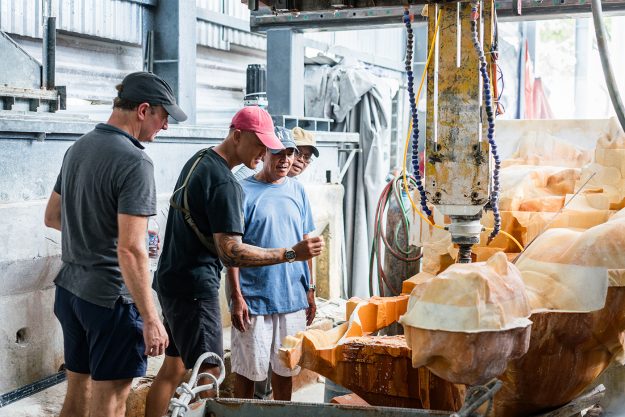 Tuan Andrew Nguyen (second from left) and the production team at the stone fabrication workshop in Da Nang. Photo by Quinn Ryan Mattingly. Courtesy the High Line.
Repurposing weapons and remnants of war has been a major theme of your work, and in Vietnam, you’ve worked with community members to collect pieces of unexploded ordnance and recast them as sculptures. So tell us about how you transform these instruments of war. The transformation of war remnants into sculptural objects began as a way to think about memory materially. In Vietnam, war is not only something located in the past or in archives. It still exists physically in the soil, in rivers, in bodies, in landscapes that continue to carry unexploded ordnance and the toxins of war even half a century later. The war ended in 1975, but it persists as a latent presence. And so my working with this material is actually a material form of my relation with the communities that live with this material.
I think materials absorb energy. They absorb ideology. They absorb violence. A bomb or a shell casing is designed with a very singular purpose: to destroy, to fragment, to impose power. But I think once these objects are removed from their military function, they enter another cycle of meaning, potentially. In many communities in Vietnam, especially in the region where I work in Quang Tri, war remnants have long been repurposed into daily life: People turn them into spoons, pots, shovels, fences, even children’s toys. There’s already a kind of vernacular practice of transformation that emerged out of necessity and resilience. So my work is really in conversation with that existing knowledge. It’s looking at how materials can carry memory—and how they can be transformed to tell another story.
One of your guiding philosophies in creating these works is animism. So can you talk about how animism influences your work? Animism is a belief system that is still very strong in Southeast Asia, especially in Vietnam. Both my grandmothers very strongly believed in animism. At its core, animism resists the idea that the world is composed of inert objects existing solely for human use. Everything has a soul or a spirit. Materials, objects, landscapes, rivers, animals, even remnants of war possess some form of agency, some spirit or presence. And that worldview feels very deeply resonant to me, especially in relation to the histories and the materials that I work with.
In a Southeast Asian context, Buddhism and animism are not experienced as separate systems. They coexist fluidly in everyday life. One could even say that animist thought influenced ideas of reincarnation in Buddhism. In Vietnam, there are practices of ancestor veneration and spirit offerings, spirit houses, beliefs attached to specific trees or stones or bodies of water. That’s all based on animist thought.
For me, animism allows us to look at material and objects with a kind of presence, and it lends itself to this idea of reincarnation. And so when I think about material memory, it’s really based on animist beliefs that materials can have charge. They have history. And when I work to remake some of this material, I’m not trying to get rid of that history, but I’m trying to be in conversation with those histories that these materials contain.
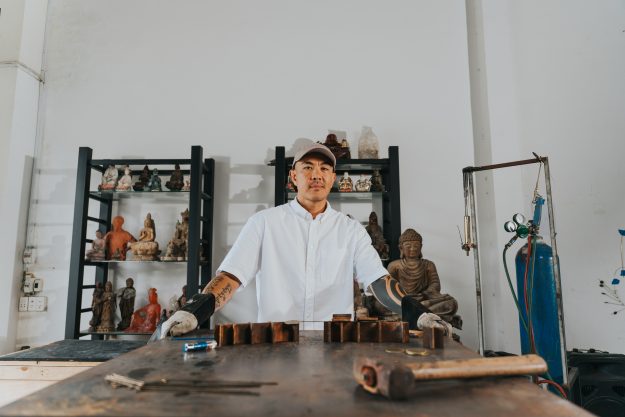 Tuan Andrew Nguyen. Photo courtesy John D. and Catherine T. MacArthur Foundation.
On that theme of reincarnation, you also repurpose materials from your films in your sculptures, and vice versa. For instance, the brass arm used as a prosthesis in your film The Unburied Sounds of a Troubled Horizon also functioned as one of the arms of Guanyin in your sculpture called Shattered Arms. So can you talk to us about this form of repurposing? My work explores this idea of transformation. When materials are repurposed, they get transformed into something with another potential, or another focus. That’s what I’m exploring: Where is that potential? How far can we take these ideas of transformation and embed them in our daily practice, in our spiritual practice, in our material practices?
Throughout history, Buddhist statues are often presented with the hands in the shape of mudras, these gestures that refer to different ideas like compassion or fearlessness. Often the hands are broken, just like in the Bamiyan Buddhas. In a lot of the statuary that survived the American War in Vietnam, you’ll find that a lot of the hands were broken or the heads were broken off. I couldn’t help but relate that to a lot of the people who I met in Quang Tri and all throughout Vietnam who had lost limbs from UXO [unexploded ordnance]. And then I also started thinking about Quan Yin, who grew a thousand arms when she understood suffering and wanted to help the world through compassionate action. This idea of losing limbs and growing limbs was something that became part of my thinking.
So the arms being cast from artillery shells kind of become an offering. In the Bamiyan Buddha, the arms are not directly connected to the stone—they float suspended in front of the stone as if they were an offering to that moment in time or to the Buddhas themselves. So that’s how I’m thinking about this idea of transformation, especially in the use of these transformed artillery shells.
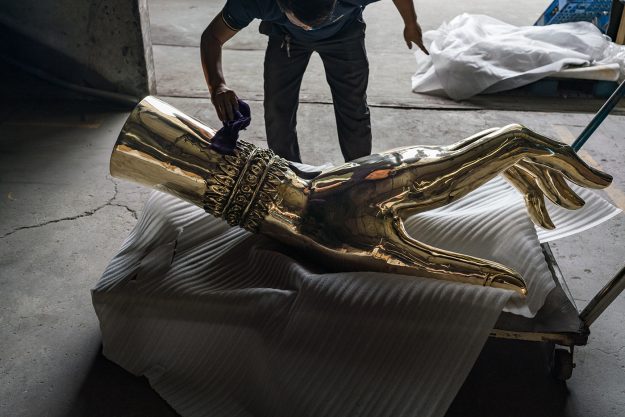 One of the two brass hands from The Light That Shines Through the Universe is polished at the studio in Saigon. Photo by Quinn Ryan Mattingly. Courtesy the High Line.
You’ve talked about how memory can be a form of resistance and empowerment, especially for communities affected by colonialism, war, and trauma. So how do you think about memory and storytelling in your work? Growing up in a very small family who had migrated from Vietnam to the heart of America, all I would do every day of my childhood was sit at the dinner table and listen to my parents and grandparents tell stories. And I didn’t know it then, but it had a profound influence on how I came to understand that stories are a very powerful form of forgetting. Memory is never just archival. It’s active; it’s contested; it’s often embodied, especially in communities like my own that are shaped by colonialism and war.
Memory is never just archival. It’s active; it’s contested; it’s often embodied, especially in communities like my own that are shaped by colonialism and war.
Memory is not something safely stored in the past. It’s something that continues to be negotiated in the present. I think that sometimes, especially under conditions of erasure or distortion, memory plays a very crucial and active part. So when I think about memory in my work, I think less about preservation in a static sense and more about activation: what it means to make memory move again, to make it audible, to make it visible, and to share it.
I think storytelling in that sense is very much a form of political resistance for both the storyteller and the listener—especially for the listener. Because in order to have empathy, in order to be with someone in solidarity, one has to stop and listen. So that’s a very important step for me in that act of political resistance.
This excerpt has been edited for length and clarity.