 5 months ago
11
5 months ago
11 ARTICLE AD
In reflecting on the perfect society, I think it’s relevant to consider what the perfect leader, or ruler, might be like. The Pali canon lists the ten rajadhamma, the virtues and duties of a wise ruler.
The first virtue is dana, which means generosity or giving. Any kind of ruler—a universal monarch, a prime minister, a president, a chairman— needs to have a sense of generosity, because this is what opens the heart of a human being. Just reflect on the act of giving without expecting anything in return. When we give something we like or want to somebody else, that action opens the heart. And it always engenders a sense of nobility. Humanity is at its best when it gives what it loves, what it wants, to others.
The next virtue is sila, or high moral conduct. A ruler should be impeccable in morality, a human being you can fully trust. Whether you agree with a ruler’s actions or political positions isn’t terribly important; it’s the moral integrity of the ruler that’s most important, because you can’t trust someone who isn’t moral. People can easily feel suspicious about someone who is not fully committed to refraining from cruelty, from killing, from taking things that have not been given, from sexual misconduct, from false speech, and from addictive drugs and drink. These standards of restraint are the basic moral precepts, the sīla, that you are expected to keep if you consider yourself a Buddhist.
The third virtue is pariccaga, or self-sacrifice. This means giving up personal happiness, safety, and comfort for the welfare of the nation. Self-sacrifice is something we need to consider. Are we willing to sacrifice personal comfort, privilege, and convenience for the welfare of our families? In the past fifty years or so, self-sacrifice has almost come to be regarded with contempt; it is put down as being foolish or naive. It seems that the tendency is to think of ourselves first, asking, “What has this government done for me? What can I get out of it?” But whenever I’ve thought in those ways, I’ve felt that I could not respect myself. In contrast, the times when I sacrificed myself, I’ve always felt that it was the right thing to do. Giving up personal interest, convenience, and comfort for the welfare of others—that is always something that I look back on now without regret.
The fourth virtue is ajjava, which is honesty and integrity. This means more than not telling lies to others; it means being honest with yourself, as well. You have to be undeluded by the desires and fears in your own mind in order to have a sense of personal honesty in which you are not blaming or condemning yourself or others or looking at the world in the wrong way.
The fifth virtue is maddava, which means kindness or gentleness. Living in the West, I’ve noticed that there is a tremendous desire for kindness and gentleness, and an idealism that reflects that desire. But what one finds in actual daily life is a kind of harshness toward oneself or others, a tendency to make harsh judgments, to react with anger, and to regard kindness as a bit soppy and wet. Gentleness is considered weak. So, in our monasteries, we’ve emphasized the practice of mettā, which is loving-kindness toward oneself and others. When we hold to high standards and ideals, we often lack kindness; we are always looking at how things should be, and we become frustrated with life as it is. This frustration can make us angry and cruel. To be kind and gentle can seem wishy-washy and weak, and yet it is a virtue that a wise ruler should have.
The sixth virtue is tapa, which means austerity or self-control—giving up what you don’t really need. The seventh virtue is akkodha, which is non-anger, non-impulsiveness, calmness. This one is quite difficult because it’s hard to remain calm in the midst of confusion and chaos, when things are frustrating. It’s easier to act just on impulse, speaking or acting in anger.
The eighth virtue is avihiṁsa, which means not using violent means against anyone, not being oppressive or forcing your will on other people. Even high-mindedness can be oppressive, can’t it? If you live with people who have very high standards and high ideals, they can push you down all the time with their ideas. It’s a kind of violence, even though they might believe in non-violence and think they are not acting with violence. That’s why we often tend to see high moral ideals as hypocrisy. When we talk about morality now, some people get very tense because they think of morality as being oppressive, as it was in Victorian times when people were intimidated and frightened by moral judgments. But that is not avihimsa. Avihimsa is non-oppression.
Next is khanti, which is patience, forbearance, and tolerance. To be non-oppressive and non-violent, not to follow anger, one needs to be patient. We need to bear with what is irritating, frustrating, unwanted, unloved, and unbeautiful. We need to forbear, rather than reacting violently to it, oppressing it, or annihilating it.
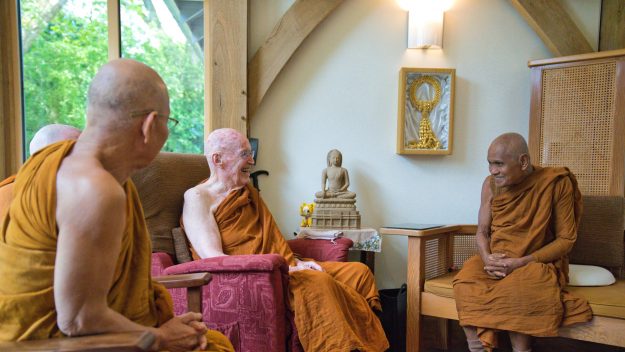 Monks meet with Ajahn Sumedho for his 90th birthday. | Image via Amaravati Buddhist Monastery.
The last virtue is avirodhana, which means non-deviation from righteousness, or conformity to the law—the dhamma. Non-deviation from righteousness sounds oppressive, doesn’t it? When we become righteous, we can often become oppressive; I’ve seen it in myself. When I get full of righteous indignation I come at people like a demon, like the Old Testament God: “Thou shalt not!” I can be pretty frightening when I’m righteous. But avirodhana isn’t that kind of patriarchal, oppressive righteousness; rather, it is knowing what is right, what is appropriate to time and place. In the West, we tend to believe that thinking rationally and being reasonable is right. So everything that seems rational or reasonable, we think of as right, whereas everything that is irrational or unreasonable, we see as wrong. We don’t trust it. But when we attach to reason, we often lack patience, because we are not open to the movement and flow of emotion. We overlook the spaciousness of life. We are so attached to time, efficiency, quickness of thought, and the perfection of rational thinking that we view temporal conditions as reality, and we no longer notice space. So the emotional nature—the feeling, the intuitive, the psychic—all are dismissed, neglected, and annihilated.
Avirodhana, or conformity to the dhamma, entails a steadiness in one’s life that enables one to conform to the way things are. The only reason we don’t conform to it is that we don’t know it. Human beings are quite capable of believing in anything at all, so we tend to go every which way and follow any old thing. But once we discover the dhamma, our only inclination is to conform to the law of the way things are.
The Wise Ruler Within
So these are the ten rajadhamma, the virtues of a universal ruler. We might think, “Well, that’s what the prime minister or president should be doing. Maybe we should send them the list and leave it up to them.” But we can also ask, “Where within ourselves might we find the wise ruler?” This is the way of reflection.
You can apply these virtues to the practical experience of being a human being, rather than just looking at them as a way of judging the present rulers of the world. We could get into a lot of interesting criticisms, if we decided to see how much dana, sila, or pariccaga the president or prime minister has. But that would be of no value. We could figure out what they should do, but we wouldn’t have the vaguest idea of what we should do—how our lives should change. Yet the more we move toward developing the wise ruler within, the more chance there is of actually getting a wise ruler outside, sometime.
We can ask, “Where within ourselves might we find the wise ruler?” This is the way of reflection.
We can, in daily life, move toward these virtues. They are not to be used as judgments against ourselves, to say: “Oh, I’m not generous enough; my morality isn’t good enough; I’m too selfish to think of sacrificing myself.” But we look at this list in order to aspire and move upward in daily life experiences. To be able to do this, we need to begin to know ourselves as we are, rather than making judgments about ourselves as we think we should be. Then, by understanding ourselves, we will understand everyone else, and we’ll begin to understand society.
So, a perfect society can only happen when there are perfect human beings. And what is a perfect individual human being? One who is not deluded by the appearance of the sensory realm, one who has transcended that. When there is not a concept or an attachment to a selfish position, a selfish view, generosity becomes a natural way of relating. One wants to share. One recognizes just what is needed, and one is willing to share the extra. The tendency toward hoarding things up for oneself diminishes.
In the world today, we see a terrible discrepancy between the affluent Western world and the poverty-stricken Third World. We live at a very high standard of living, while most of the people in the world live at a very low standard. Many are not even able to get enough to eat. We can contemplate this as not being right. We can condemn the Western world, or we can try to justify our affluence and feel sorry for the Third World.
But what can we actually do about it? As individuals, we don’t have enough influence with the governments and leaders of the affluent West to really change much on that level. But we can change the way we relate to the world, can’t we? We can learn to practice meditation. And we can learn to live in a way whereby we become less and less selfish, so that we are willing to share what we have with others. Then we find the joy of sharing as the reward—but not an expected reward.
We can contemplate sila, asking ourselves what we are doing now to live in a way that is not harmful to other creatures. We can refrain from violent actions and speech, from exploitation, from all that causes division, confusion, anguish, and despair in the lives of other beings. We can practice—with our family, with our fellow workers, with our society—how to live in a way that is non-violent, that is moral, and in which we accept responsibility for what we say and do.
We can reflect on pariccaga, self-sacrifice. But by self-sacrifice, I don’t mean a kind of soppy martyrdom where I’m sacrificing myself for this no-good lot. Self-sacrifice doesn’t come from self-involvement, but from no longer regarding oneself as more important than anyone else. You have to know yourself before you can do that. The idea of sacrificing yourself without knowing yourself only makes you one of those sentimental martyrs. Self-sacrifice comes from mental clarity, not from sentimentality.
We can contemplate ajjava, honesty and integrity, as well as maddava, kindness and gentleness. We can be attentive to life in a way that is gentle and kind. The reason we lack kindness is not that we don’t want to be kind; it’s that we are too impatient to be kind. To be kind you have to be patient with life. To be gentle with life means you have to give in a lot; you can’t just bend things and force things to fit your ideas for your own convenience, or for efficiency. Kindness means that you are learning— just in little things in daily life—to be more gentle and open, especially with things you don’t like or don’t want. It’s easy to be open to the things you like. For example, it’s easy to be kind to little children when they are being sweet and lovable, but to be kind to that which is annoying, irritating, or frustrating takes considerable attention, doesn’t it? We have to put forth the effort not to react with aversion. It’s very good for us to work with the irritations of daily life in little ways—to try to be gentle and kind in situations in which we are inclined to be harsh, judgmental, and cruel.
It’s useful to ask yourself how much you really need, and how much is just an indulgence. This questioning is not passing judgment; it’s beginning to note what is the right amount, noting what is necessary and what is indulgence.
We can contemplate tapa—self-control, non-indulgence, austerity. Austerity is a frightening word for the modern age; it’s daunting. But it’s useful to ask yourself how much you really need, and how much is just an indulgence. This questioning is not passing judgment; it’s beginning to note what is the right amount, noting what is necessary and what is indulgence. This takes attentiveness and honesty.
We can reflect on akkodha, non-anger and non-impulsiveness; avihiṁsā, non-violence and non-oppression; khanti, patience and forbearance; and avirodhana, non-deviation from righteousness. The more we are aware of these virtues, the more they can manifest in our lives.
♦

© 1994 by Ajahn Sumedho, The Mind and the Way: Buddhist Reflections on Life. Reprinted by arrangement with Wisdom Publications.